School marketing in the age of AI: do we need students' faces?
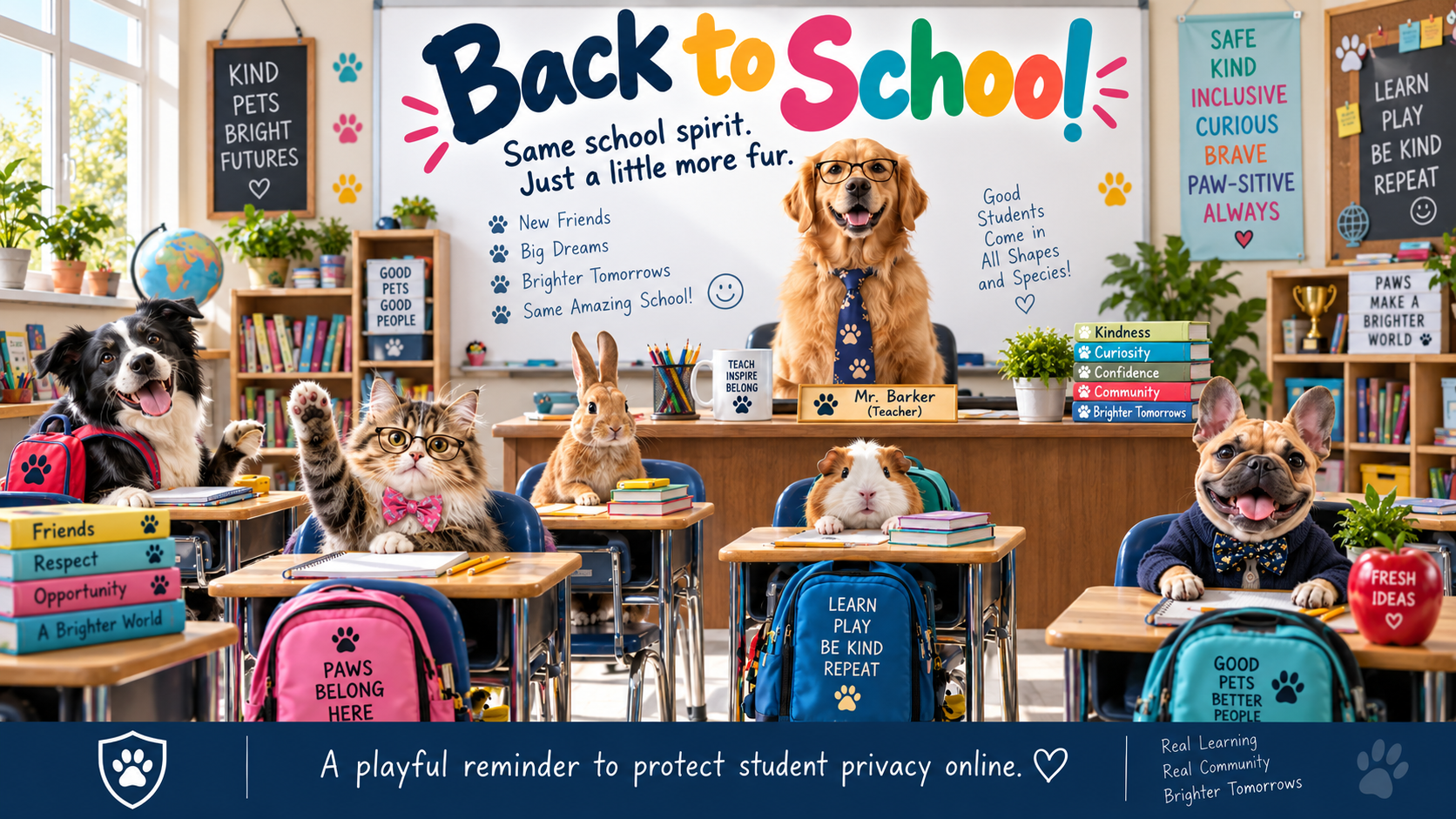
Schools should be able to celebrate learning while exposing less of children’s identities online. My view is that an identifiable face in public school marketing should need a clear, documented purpose, with consent and a considered assessment of the exposure involved.
That matters for independent schools, Catholic schools and state schools across Queensland and Australia. It also deserves attention from sporting clubs, charities and other organisations that feature children in promotional imagery.
The question is whether the value of publishing an identifiable photograph justifies the exposure we create for the person in it. A signed photo consent form is part of that decision. It cannot prevent someone else copying or manipulating an image.
On 28 July 2026, the eSafety Commissioner published advice on sharing school imagery in the age of AI. It describes rising reports of school-related image misuse, including sexualised deepfakes and abuse targeting staff. Between January and March 2026, eSafety received more than 100 reports about anonymous accounts targeting schools and staff; almost all involved imagery taken from school websites or social media.
The advisory recommends reviewing image-sharing practices. Posting fewer images, or none, can reduce exposure, although it cannot eliminate misuse. Its advice is to assess purpose, consent, audience and identifying details before publication.
This advisory does not announce a federal ban on school photographs. eSafety explains that it can act against certain harmful material under the Online Safety Act, including issuing removal notices for image-based abuse, but some harmful content falls outside its legal thresholds. Schools have good reason to act before relying on a later takedown.
Creating sexualised images of children is an abusive use of AI. The responsibility belongs to those who create and circulate that material. Schools can still make considered decisions about the images they make available.
In its 11 September report, 7NEWS said Tyndale Christian School Group had stopped publishing identifiable student photographs on public social media. Tyndale described a proactive privacy and digital-safety review, with no single incident prompting the decision.
St Hilda’s Anglican School for Girls in Western Australia announced its approach on 27 January 2026: avoiding clearly identifiable student images on public social media, with alternatives including side profiles, silhouettes, backs of heads and distant group shots. Hope Barr, the school’s Head of Marketing and Communications, explains that families can access a password-protected gallery, with downloads limited to images featuring their daughter.
In Queensland, Brigidine College in Brisbane had also acted before July’s advisory. ABC News reported on 19 April 2026 that it had restricted recognisable student photographs and reduced images per post. Its approach included side profiles, group shots and photographs from behind. Principal Brendan Cahill linked the change to AI image-manipulation concerns; parental consent remained part of the process.
That gives schools a useful distinction between communicating publicly and sharing family memories. Restricted access reduces the audience; recipients can still copy or reshare images, so expectations and access controls matter.
Jacob Shultz’s earlier provocation about school marketing asked what happens when social media stops being the default. His suggestions included direct relationships through mailing lists, events and spaces schools can manage more carefully.
A school can explain its teaching, show student projects, invite families onto campus and communicate its values without a steady stream of identifiable children’s portraits.
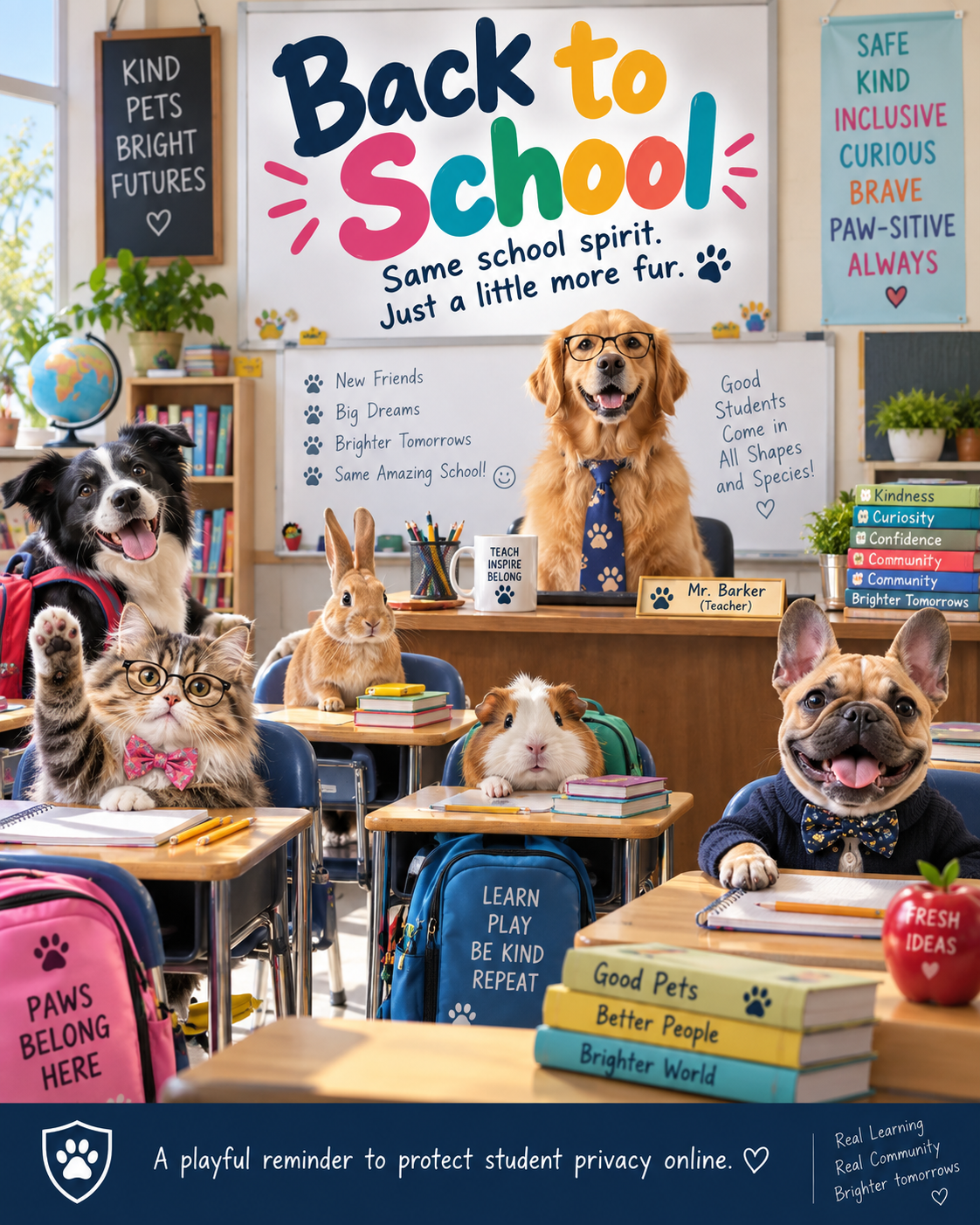 A playful back-to-school concept using animals. Clearly fictional illustrations can give a campaign personality without exposing a child’s identity.
The animal classroom illustrations here make that point with some humour. Other options include hands building a project, artwork with names removed, equipment and spaces. A photograph taken from behind or side-on may tell the story with less facial detail. Every composition still needs checking for recognisable features, names and context. Staff participation deserves the same consideration.
The sideways-turn advice has a research basis. Yisroel Mirsky’s 2022 DF-Captcha preprint proposed head turns and other challenges to expose live deepfakes. Its preliminary experiments showed visible defects when challenging the tested facial reenactment system. The paper identified difficulties generating poses and actions poorly represented in training data.
These are historical tests of making a fake face follow a caller’s movements live. They do not measure whether a published profile photograph can support a convincing edited image, or establish a reliable detection trick for today’s systems. A side profile and a cropped frontal photograph also reveal different information.
Rafay Baloch recommends considering abstract or partial-face profile images and limiting detailed facial imagery. That is precautionary advice; the post provides no comparative measurements of protection.
Research at ICCV in 2017 already demonstrated generating frontal views from profile photographs while retaining identity cues. This does not guarantee accurate recovery of hidden details, but shows why a profile is not a dependable technical barrier.
Schools can reduce unnecessary identifying material now and review their approach as technology changes. I have not found a validated percentage reduction in deepfake risk from a half-face crop; it should never become an automatic approval rule.
I have seen the need for scrutiny first-hand. At a school that was not a state high school, I saw a certificate photograph exposing a student’s name and student number. I contacted the school privately, and it blurred the image. This shows how a celebratory post can disclose more than intended.
On the few North Queensland state high school pages I have viewed, student images remain common. I have also noticed marketing and communications roles advertised in Queensland state schools. Those staff need clear expectations and leadership support.
The Department of Education already has a social media promotion procedure covering consent, approvals, training and moderation. Its consent procedure requires consent to be voluntary, informed, specific and current.
As at 12 September 2026, I could not find an explicit direction to stop identifiable student photographs because of AI deepfakes in those two public procedures or the department’s social media policy. That is a limited observation: the promotion procedure also links to employee-only guides that I could not review.
I would welcome a formal recommendation from Australian education bodies, with independent school associations asking members to agree to a common framework and education departments providing equivalent direction. My preferred starting point would be to use identifiable faces only where necessary and justified, supported by:
- Photography briefs with examples staff can use immediately.
- An approval process that checks the whole image and caption, including certificates, badges and identifiers.
- Separate arrangements for public campaigns and restricted family sharing, with clear consent choices.
- A scheduled review of public archives, respecting applicable recordkeeping requirements.
- A named person responsible for training, concerns and responding to image misuse.
A shared framework would give principals, boards and marketing staff an agreed position to explain to families. At the next marketing meeting, redesign one campaign to expose less of students’ identities, then record when identifiable imagery would be justified in the school’s publishing policy.