Service doesn't always happen on a stage
There are plenty of visible ways to serve in a church.
Preaching. Leading worship. Welcoming people at the door. Teaching children. Praying with someone. Making a meal.
But service doesn’t always happen on a stage.
Sometimes it looks like turning up with a toolbox, tracing cables through a building, fault-finding an HDMI system and trying to leave something working better than you found it.
That was what serving looked like for me recently.
There was an issue with one of our church projector systems at Northreach Baptist Church, involving a HDMI-over-Ethernet link that wasn’t behaving as it should. So I packed some equipment, headed to church and spent some time working through the problem.
Eventually, I got it going.
There is certainly satisfaction in solving a technical problem. Anyone who enjoys working with technology probably knows the feeling when you finally identify the fault and everything springs back to life.
But driving home, I found myself thinking that there was something much more significant about it.
I was able to help because, over many years, other people had first taken the time to help me.
From overhead transparencies to digital everything
Some of my earliest memories of serving at church involve an overhead projector.
For those fortunate enough to have missed that era, song lyrics were printed onto transparent sheets and physically moved across an illuminated glass surface so they could be projected onto the wall or screen.
There was no ProPresenter.
No confidence monitor.
No HDMI matrix.
No networked AV.
You moved the transparency at approximately the right moment and tried not to put your hand across the projector in the process.
And I loved it.
I was young, but somebody had given me an opportunity to contribute.
Our church technology changed considerably over the years.
I just missed the era where an organ dominated the music and instead grew up around a relatively small worship band. Audio systems developed. Projectors improved. Computers became an increasingly important part of running a service.
I went from moving transparencies to operating visuals and sound, running cables and gradually learning more about how all of these systems worked together.
For a while, serving also meant standing at the front rather than sitting behind the desk. In my later years of school I had the opportunity to play guitar in some of the morning and evening music teams. It was a pleasure to play, and to worship publicly, during the season of life when I was able to. I am thankful for that time.
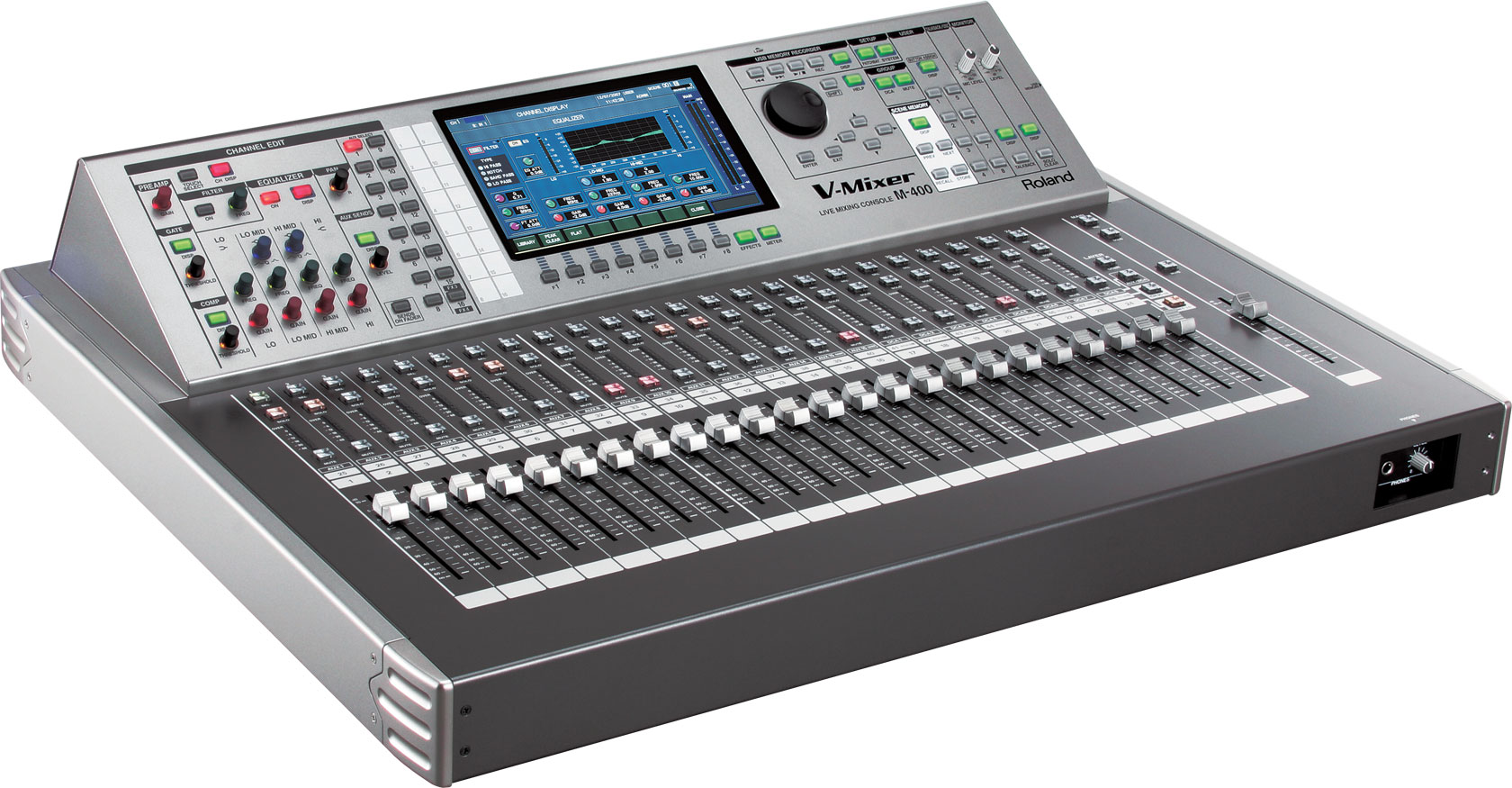
Then came one of the upgrades that seemed enormous at the time: moving from an analogue mixing console to a Roland M-400 digital console and Digital Snake.
Wow.
For a young bloke interested in technology and audio, that thing was a beast.
Suddenly we had moving faders, scenes, digital routing and audio travelling over network cabling rather than a huge traditional analogue multicore.
The Roland M-400. Moving faders, scenes and audio over a network cable felt like the future at the time.
Today, even that console belongs to another generation. More recently I have worked with Allen & Heath digital systems and technology has continued moving forward.
The equipment has changed.
The purpose hasn’t.
Somebody took the time to show me
Looking back, the thing I appreciate most isn’t the equipment. It’s the people.
I didn’t arrive one Sunday already knowing how to operate an audio system, terminate cables, troubleshoot AV gear or manage a website. People showed me. Volunteers gave up their time, let me stand beside them, explained why something had been wired a particular way, and showed me how to run a cable properly rather than just getting it from one end of a building to the other. They let me operate equipment, and they trusted me enough to make mistakes and learn from them.
Over the years that grew well beyond Sunday services, into websites, computers, networks and other systems to look after, with always something else to learn. Those people weren’t running a training program. They were simply serving, and while they did it they took the time to bring somebody younger alongside them.
Years later, much of what began through volunteering has crossed into my professional life: troubleshooting, working methodically, audio visual systems, networking, web development, working with other people, and trying to do a job properly rather than just enough to make it work. God has been extraordinarily good through all of that. Something that started with moving transparencies on an overhead projector became part of a much bigger journey of learning, serving and eventually working professionally with technology.
You can read more about that journey in my testimony.
Using what we have been given
There is a verse in 1 Peter that captures this well:
Each of you should use whatever gift you have received to serve others, as faithful stewards of God’s grace in its various forms.
1 Peter 4:10
I love the breadth of that. Whatever gift you have received. Our gifts aren’t all the same, and they aren’t supposed to be.
Some people teach God’s Word from the front. Some sit beside someone who is hurting and know exactly how to listen. Some lead music, some work wonderfully with children, some organise, some cook, some encourage, some arrive early to put out chairs and stay late to pack them away. And some of us apparently enjoy crawling behind projector screens working out why an HDMI signal isn’t reaching the other end.
There is room for all of it. Paul gives us the same picture in 1 Corinthians when he describes the church as one body with many parts: different functions, each contributing to the whole. That is worth remembering in churches where the most visible ministries can look like the most important ones. They aren’t.
The goal isn’t recognition, or being able to point at something and say, I did that. It is to use what God has entrusted to us in a way that helps His church do what it is here to do. If fixing a projector means the congregation can see the words on Sunday, fix it well. If a website helps someone find the church and walk through the doors, build it well. If a cable means someone can clearly hear the gospel preached, run it well.
The privilege of being useful
That is one of the things I have come to enjoy most about serving: being useful. Not indispensable — no church should depend on one person knowing how everything works — but useful. There is joy in looking at a problem and saying, I think I can help with that, applying something you have learned, and leaving things in a better state than you found them for the next person.
And there is a greater satisfaction in knowing the thing you’ve repaired or built isn’t really the point. The projector isn’t the ministry. Neither is the mixing console, the network or the website. They are tools. They help someone preach, a worship team lead, children learn, people communicate and a church welcome its community. Seen that way, even ordinary technical work can become an act of service.
Passing it on
Perhaps there is a responsibility that comes with this. Someone showed me, so I need to be willing to show somebody else.
The best thing to do with the knowledge we accumulate isn’t to become the person everybody calls when something breaks. It’s to bring other people alongside us: explain what we’re doing, give somebody younger a go, let them push the buttons and run the cable, let them make a mistake while we’re there to help, and trust them with harder things over time. That investment can reach much further than we ever see.
I know, because other people did it for me. Some of the volunteers who patiently showed a young Nicholas how things worked couldn’t have known where those skills would eventually take me, or that decades later I would still be using them to serve. But God knew, and I am enormously thankful for them.
Different gifts. One purpose.
So yes, I was pleased when the picture finally appeared on the projector again. Problem solved, tools packed away, job done. But the more important thing was the reminder it gave me.
God gives us different abilities, places people around us who help develop them, and gives us opportunities to learn, to work and to serve. We get to decide what we do with them. For me, that still sometimes means cables, computers, networks, mixing consoles and projectors — and after all these years, I genuinely enjoy it.
The technology will keep changing. The gear we install today will look as dated as that overhead projector one day. But I hope one thing doesn’t change: that we keep using whatever God has placed in our hands to serve one another, and that while we do it, we bring somebody else alongside us.
Different gifts. Different roles. One purpose — serving Christ and serving one another.
Each of you should use whatever gift you have received to serve others…
1 Peter 4:10
This reflection sat close enough to my working life that it felt at home here rather than on my personal blog. For other personal writing on family, faith and everyday life, visit blog.nickosullivan.id.au.