North Queensland Cyber Watch: ransomware hits Townsville Christian College
This is the fourth entry in North Queensland Cyber Watch, an ongoing series looking at cyber security incidents affecting our region and what organisations here can take from them. The intent of this series isn’t to alarm anyone or pile on an organisation already having a bad week. It’s to turn each incident into a practical prompt: could this happen to us, and are we ready if it did?
This entry is a hard one to write, because it’s close to home. Townsville Christian College is a well-regarded, multi-cultural, co-educational independent school in our own community, and I say the following as someone from the North Queensland education community first, and a cyber security commentator second. In recent years they moved from a single building located in an industrial part of Townsville to a master-planned site - What an effort for the Church that planted the school.
What was reported
According to reporting by the Townsville Bulletin (Cameron Bates, 31 July 2026), Townsville Christian College has confirmed it was the target of a criminal ransomware attack between 28 and 30 June 2026. An external attacker gained unauthorised access to part of the College’s network through an internet-facing remote-access connection, obtained administrative access, and encrypted a number of the College’s systems.
The College’s own notice to parents, guardians and staff — issued under the Notifiable Data Breaches scheme in the Privacy Act 1988 (Cth) — set out what happened, plainly and without spin:
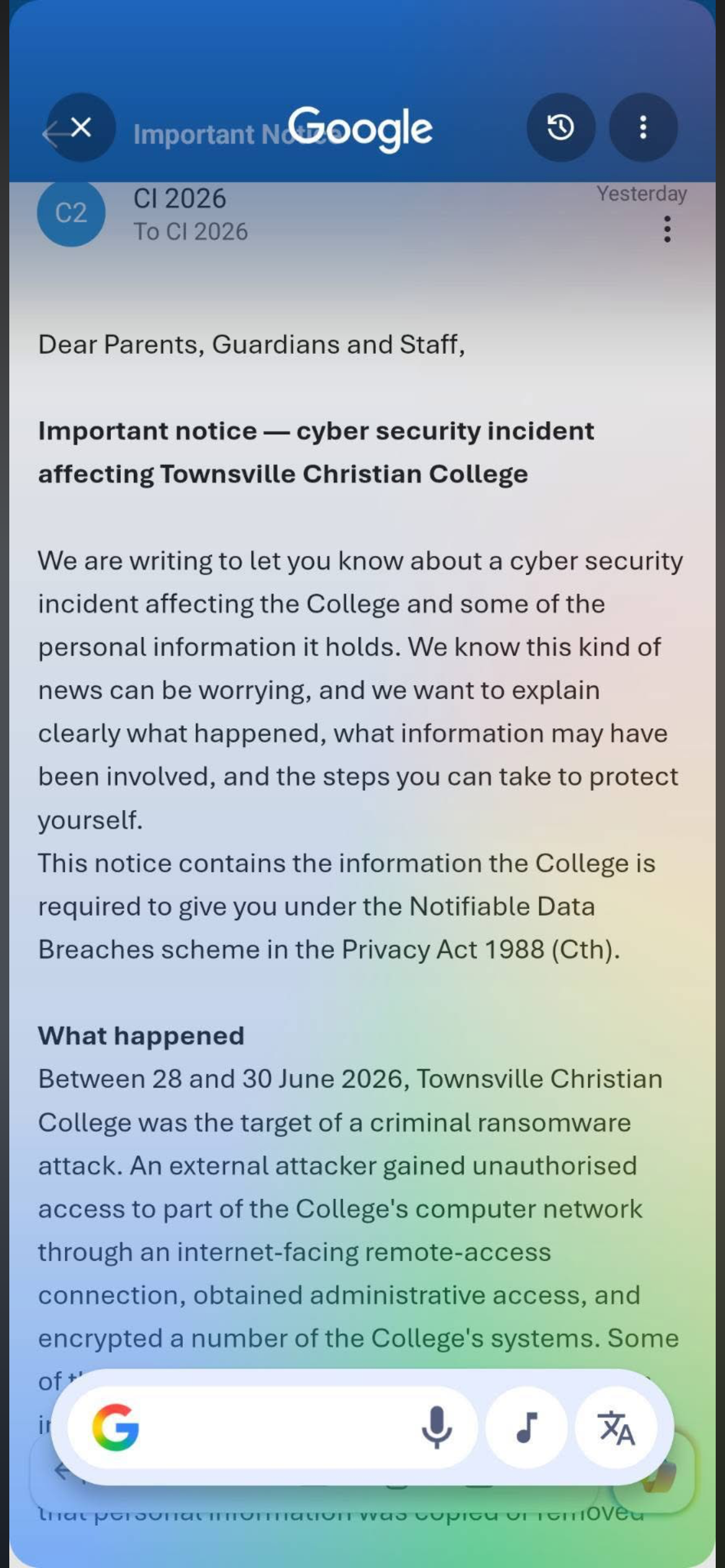
The notice was quickly being shared and discussed in local community groups such as Everything Townsville — a reminder that a breach notification doesn't stay contained to the families who receive it directly.
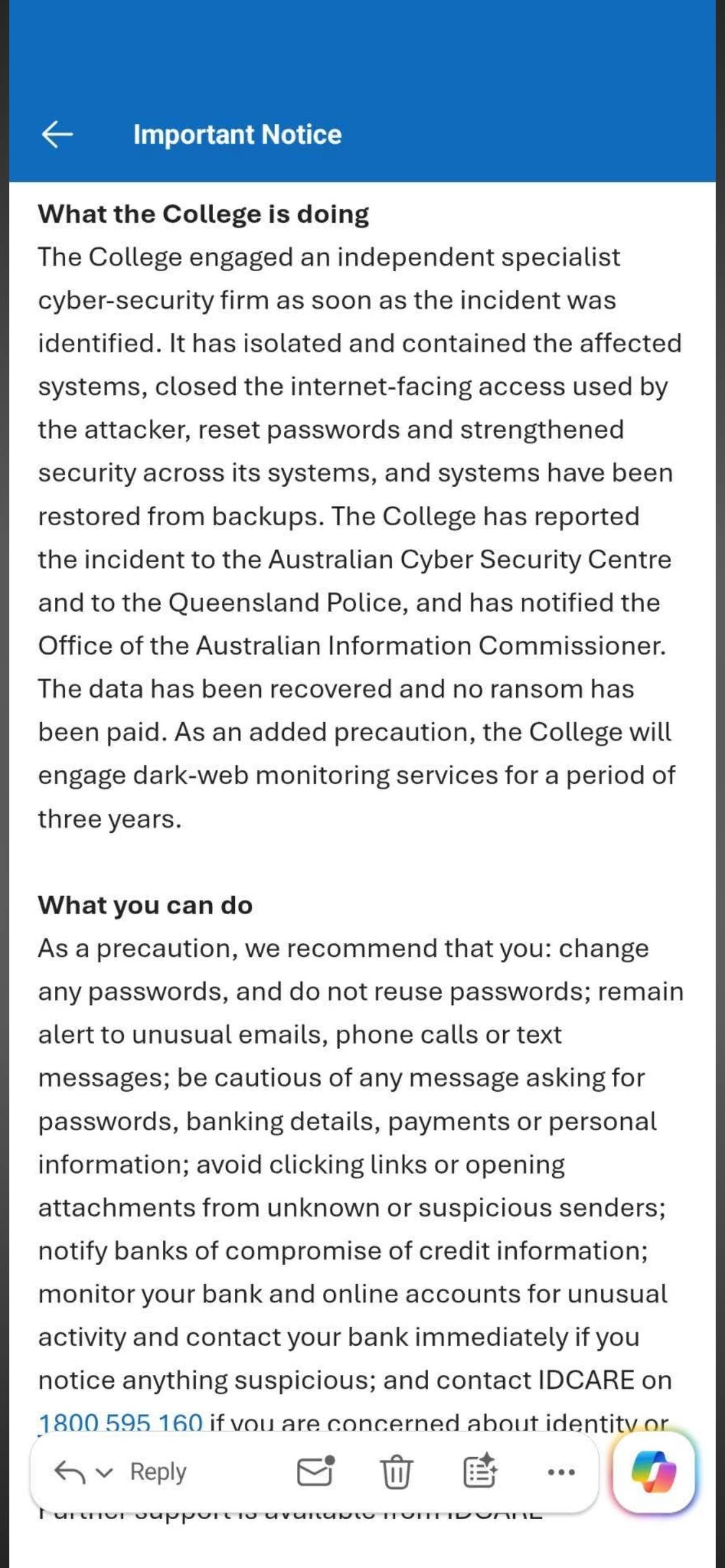
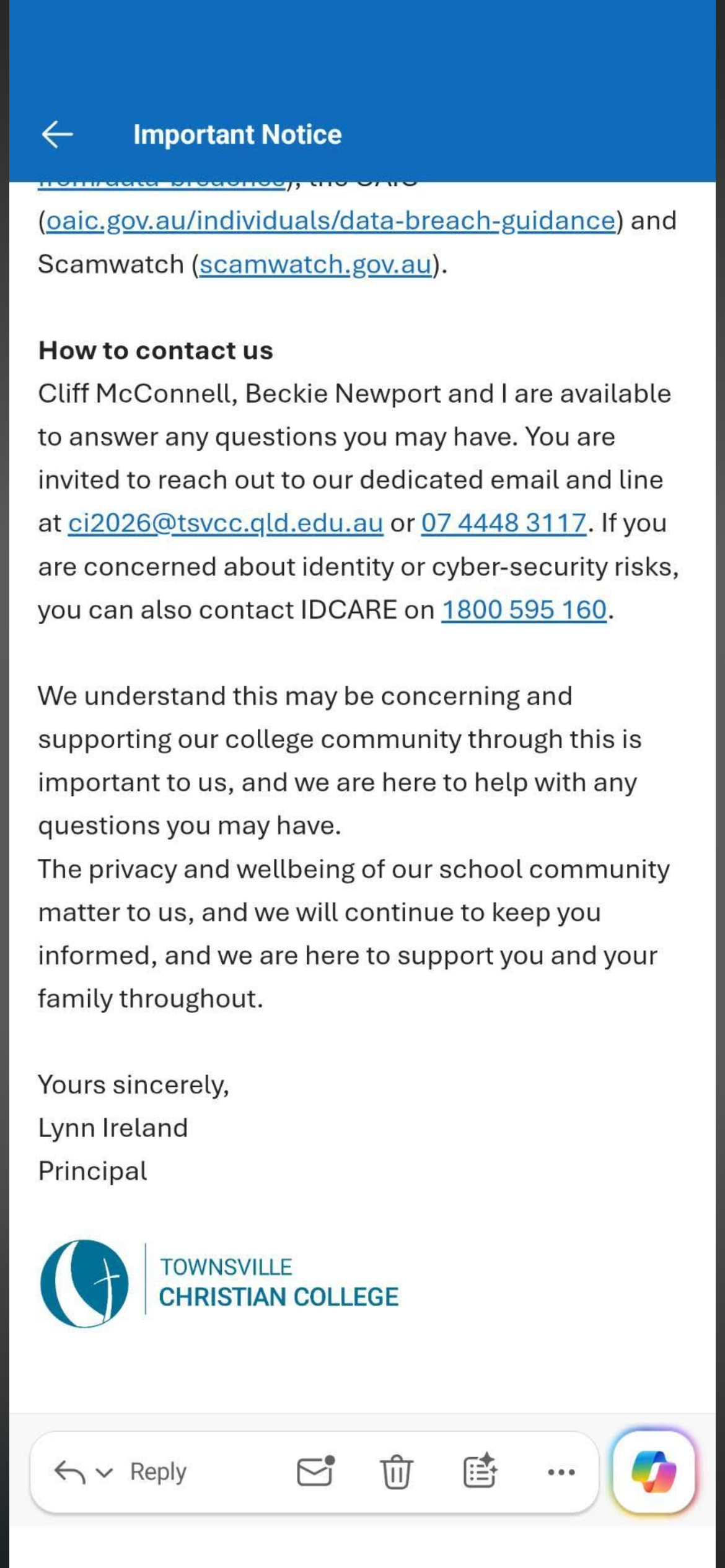
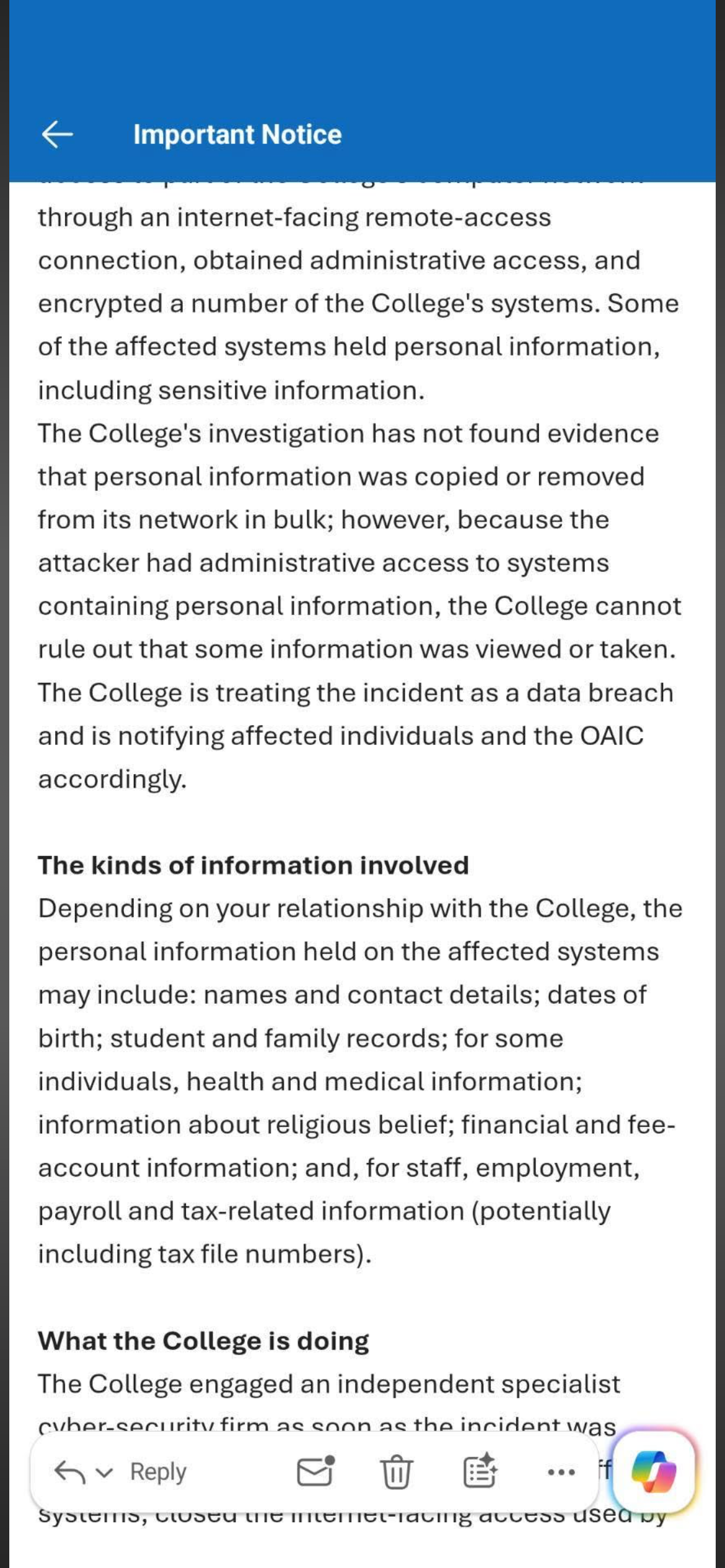
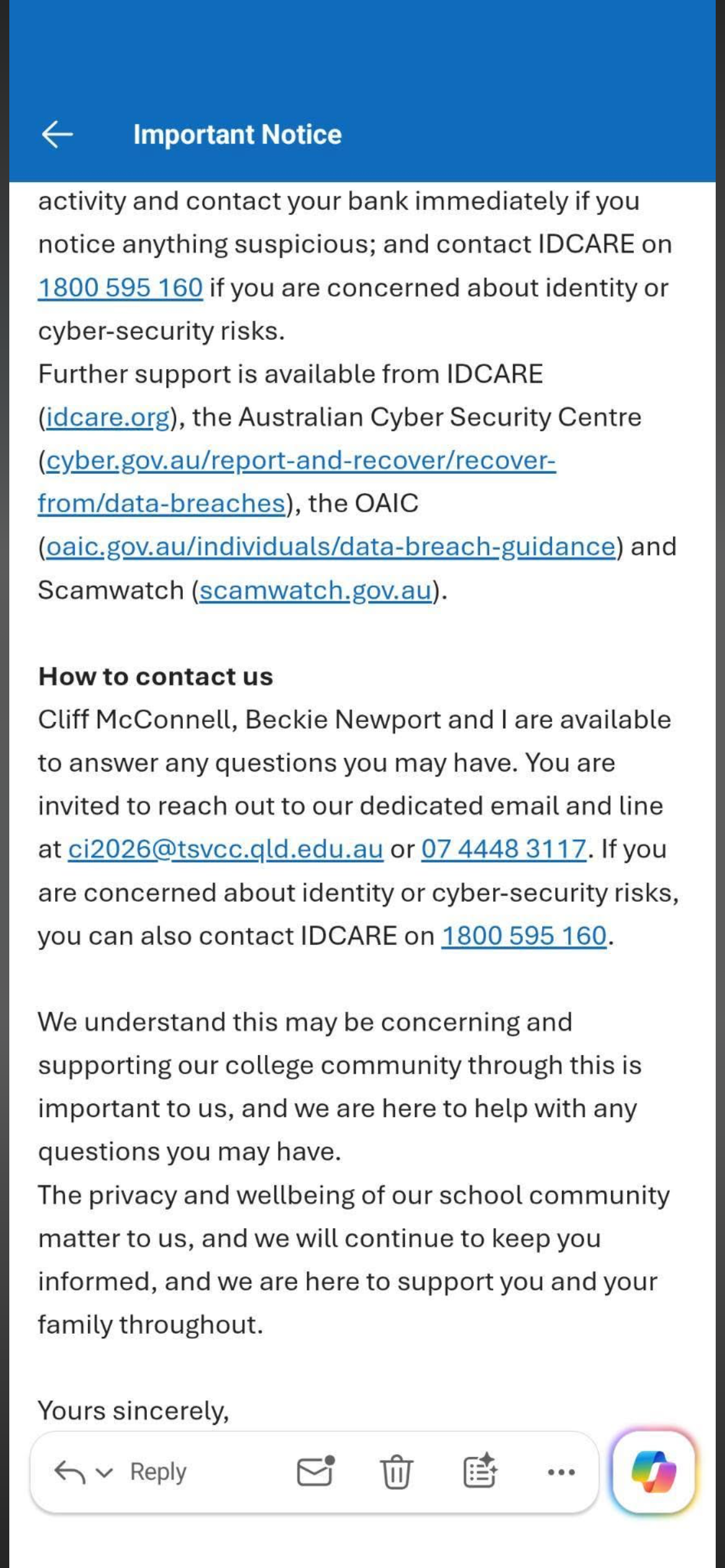
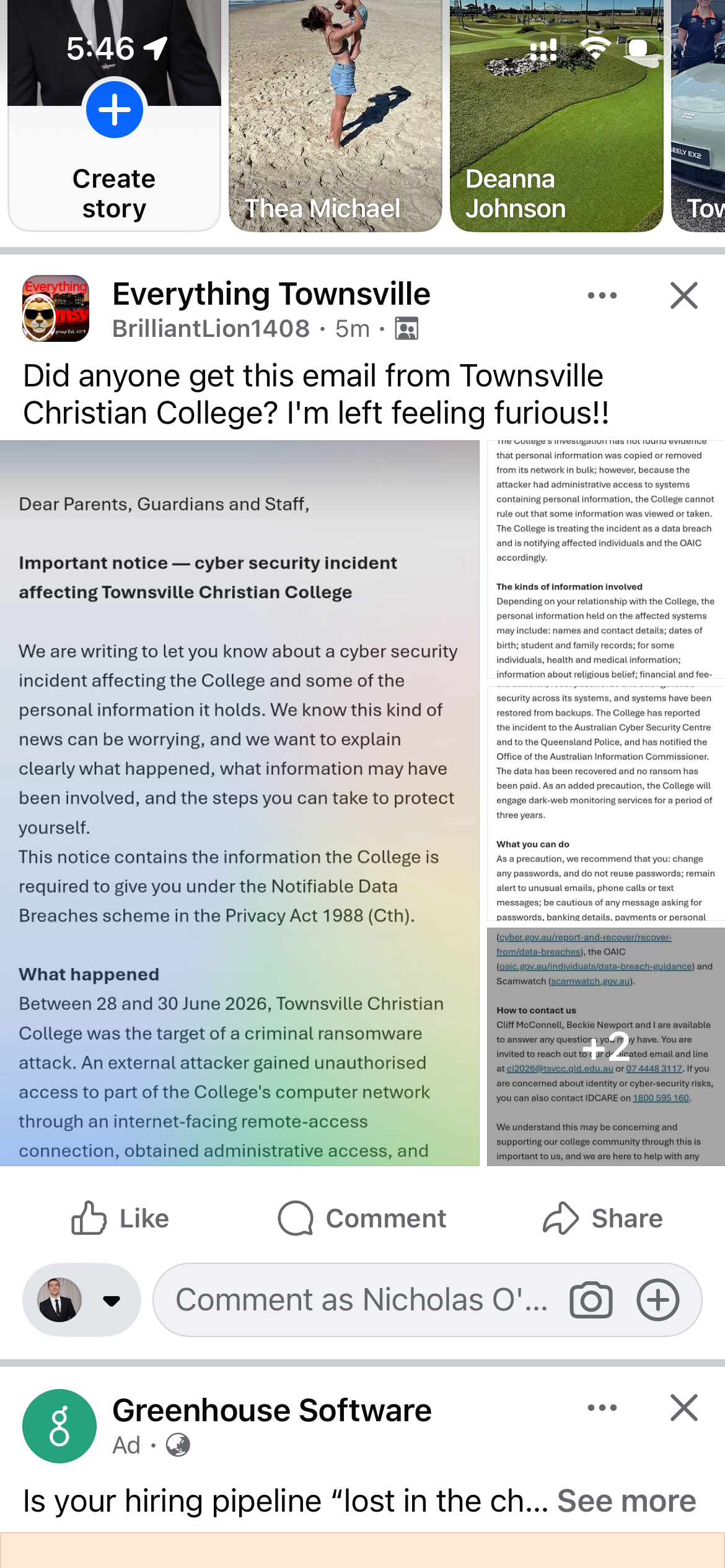
By the College’s own account:
- Some of the affected systems held personal information, including sensitive information — the categories disclosed include names and contact details, dates of birth, student and family records, health and medical information, information about religious belief, financial and fee-account information, and for staff, employment, payroll and tax-related information (potentially including tax file numbers).
- The investigation found no evidence that information was copied or removed in bulk, but because the attacker had administrative access to systems containing personal information, the College cannot rule out that some information was viewed or taken.
- The data has been recovered from backups, and no ransom has been paid.
- The College engaged an independent specialist cyber security firm, isolated and contained the affected systems, closed the internet-facing access used by the attacker, and reset passwords and strengthened security across its systems.
- It reported the incident to the Australian Cyber Security Centre and Queensland Police, and notified the Office of the Australian Information Commissioner (OAIC).
- As an added precaution, the College will engage dark-web monitoring services for a period of three years.
Principal Lynn Ireland’s message to the college community put it simply: “By the grace of God, the impact could have been far greater and we are grateful that the outcome has not been more severe… While no organization wants to experience an event like this, we accept our responsibility to respond openly and transparently, while doing everything we can to minimize the consequences.”
Commending the response
It would be easy for a series like this to only ever point out what went wrong. This is a good moment to point out what went right.
Reading the notice above, Townsville Christian College did close to everything you’d want an organisation to do after a ransomware attack: it engaged specialist help immediately, contained the incident rather than letting it spread, closed off the access the attacker used, restored from backups instead of paying the ransom, reported to the right authorities without being compelled to, and wrote to its community in plain, specific language rather than vague reassurance. Naming the categories of data involved, providing a dedicated contact line, pointing families to IDCARE, and committing to three years of dark-web monitoring all go beyond the legal minimum. That’s a genuinely well-run incident response, and it deserves to be recognised as one — not every organisation gets this right on the first, worst day.
Why this matters beyond one school
In CIA Triad terms, this incident hits two of the three pillars at once: systems were encrypted (an availability failure) and administrative access was obtained to systems holding sensitive personal information (a confidentiality risk), even without confirmed bulk exfiltration. That combination — lock everything down, then leverage the threat of exposure — is precisely the modern ransomware playbook, and it’s the same pattern we looked at with the Mackay Sugar attack earlier in this series.
It’s also worth noting plainly: this is the second Townsville-based faith education provider to disclose a serious cyber incident to families in as many months, after Townsville Catholic Education’s auto-forwarding breach in June. Townsville Christian College and Townsville Catholic Education are entirely separate organisations, but the near-identical initials aren’t the only thing they now have in common. Two unrelated incidents, at two unrelated schools, inside one region, inside a few weeks, is not a coincidence to wave away — it’s a pattern. As our earlier look at Aon’s 2026 Independent Schools Risk Report showed, cyber risk is now the number one concern independent schools report nationally, and reported attacks are rising year on year. North Queensland schools are not an exception to that trend; they are a live illustration of it.
What every school and corporate entity in the state should take from this
The Australian Signals Directorate’s Australian Cyber Security Centre (ASD’s ACSC) has been consistent in its guidance for several years now: for organisations holding valuable data — and schools, with health, financial and identity information on thousands of families, absolutely qualify — ransomware readiness is not a hypothetical. It is a matter of when, not if. Townsville Christian College’s own principal said as much in substance: it happened here, and the outcome could have been far worse.
That means every independent school, and every corporate entity, across Queensland should be able to answer these questions before an incident, not during one:
- Do we have a written, tested incident response plan that names decision-makers — not just an IT contact — covering who talks to families, staff, media, regulators and the board while systems are down?
- Are backups actually tested by restoration, not just confirmed as “completed” in a dashboard? Townsville Christian College’s recovery without paying a ransom only worked because its backups were good enough to rely on.
- Is remote access to our network secured and monitored? An internet-facing remote-access connection was the entry point here — the same category of exposure ASD’s Essential Eight controls (patching, multi-factor authentication, restricting administrative privileges) are specifically designed to close off.
- Do we know who to call in the first hour? Specialist cyber security responders, the Australian Cyber Security Centre, and — for a genuine incident — the police and OAIC where applicable. ASD’s ACSC publishes practical, free ransomware guidance and a Business Continuity in a Box toolkit aimed squarely at smaller organisations that don’t have a large internal security team.
- Have we rehearsed the communication, not just the technical recovery? Townsville Christian College’s notice is a genuinely good template for how to tell a community what happened without either minimising it or causing panic — that’s worth studying, not just admiring.
None of this requires a school or business to become a security company. It requires deciding, in a calm moment, what the plan is — before a criminal group decides that moment for you.
If your school or organisation wants an outside, practical view on readiness — incident response planning, backup testing, remote access hardening and Essential Eight alignment — Suburban Secure’s managed IT services and network security services are built around exactly this kind of conversation, including for organisations around Townsville and North Queensland.
To Townsville Christian College’s leadership and staff: thank you for handling a genuinely difficult situation with transparency and care for your community. And to every other school and organisation reading this — regional, independent, public, corporate — take this as the prompt it’s meant to be. The next notice like this one shouldn’t be a surprise to whoever has to write it.