Nick and Nicholas Townsville: the Google experiment is moving
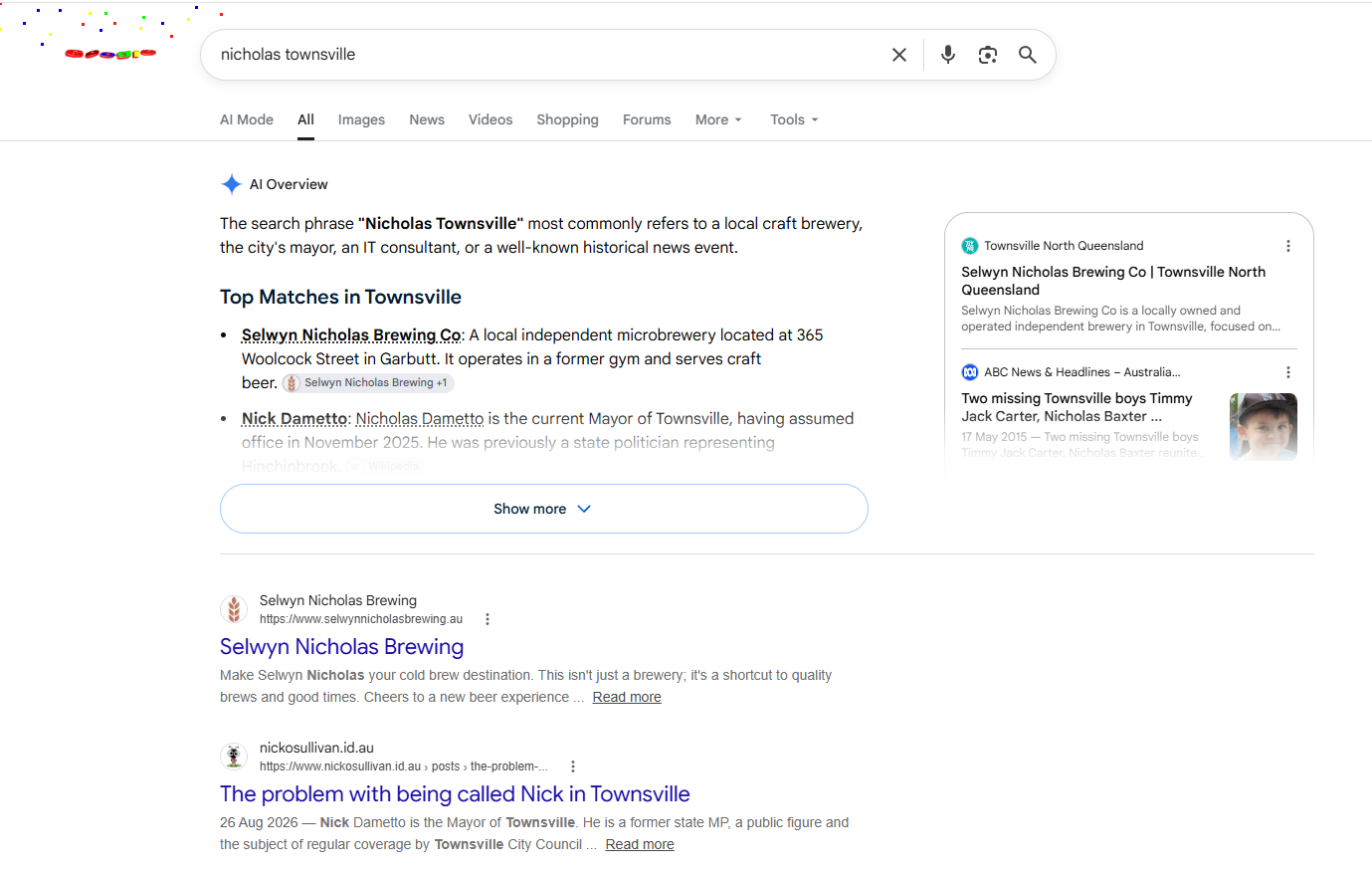
Header image: the first-page result from my latest check of “Nicholas Townsville”. Screenshots throughout this article record individual search results, which can change.
A month ago, I wrote about the problem with being called Nick in Townsville. Google had plenty to say about Nick Dametto. Establishing that there was another local Nick took a bit more work.
Then I tried my full name and discovered I was competing with a brewery.
There is now some progress to report. In my latest checks, Nicholas Townsville puts the original article on the first page, while Nick Townsville has appeared near the bottom of page one or the top of page two. Google’s AI Overview also includes me among the possible matches for Nicholas Townsville.
Selwyn Nicholas Brewing is still above me in the screenshot. They retain the considerable advantage of being able to offer visitors a beer. But the IT bloke is becoming easier to find.
Some of the most interesting discoveries in the wider website statistics have very little to do with searching for my name.
Nicholas on page one, Nick between pages one and two
In the 12 September update, I recorded this website appearing around fourth for Nicholas Townsville. The new screenshot shows the original August article directly below Selwyn Nicholas Brewing in the visible organic results.
That is an encouraging change from the earlier check. It is also interesting that Google has chosen the article about being called Nick, even though the search uses Nicholas.
For Nick Townsville, the position has varied between checks: sometimes the same article appears near the bottom of the first page, sometimes near the top of the second. It is not consistently on page one yet, but it is a useful milestone for the search that started this experiment.
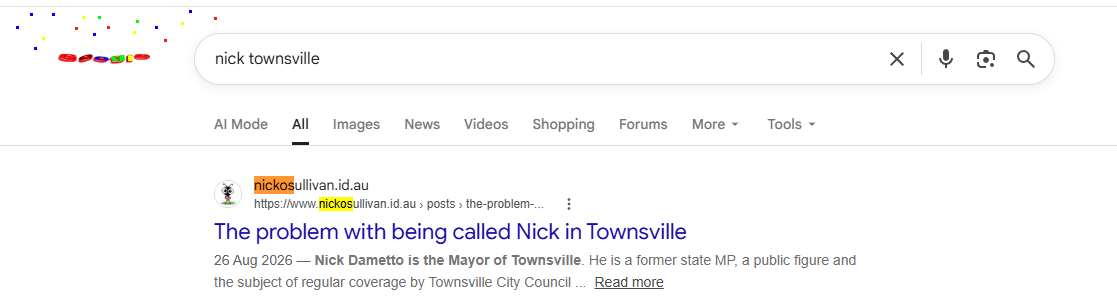 The listing from my second-page check of “Nick Townsville”. This crop shows the result itself, rather than the full page or pagination.
These are observations from my own searches. Google explains that results vary with time, location, device and recent search history. I am recording what I saw so there is something concrete to compare with later.
The Search Console export below does not contain rows for either exact query, nick townsville or nicholas townsville. It cannot give me a 28-day average position for those two phrases. The screenshots and my checks provide that part of the story.
Google has also noticed the experiment
The expanded AI Overview for Nicholas Townsville includes Nicholas O’Sullivan, describes my connection with IT and cyber security in Townsville, and even mentions the personal SEO experiment.
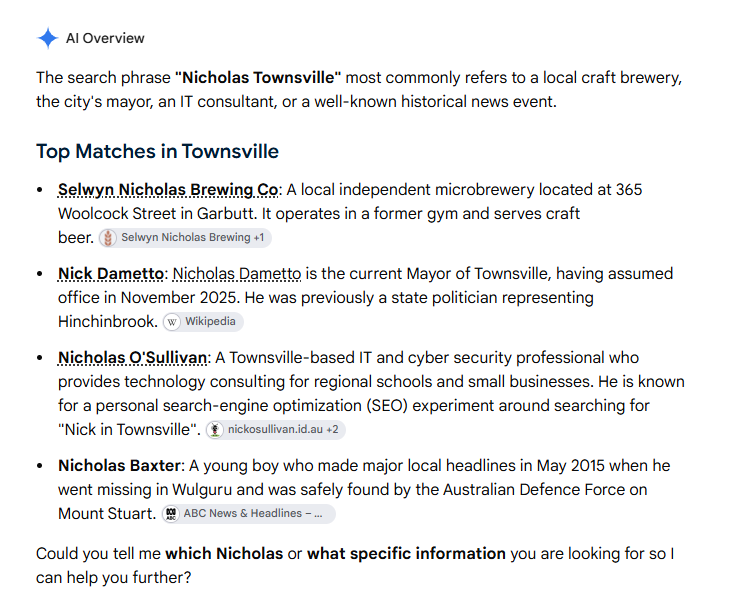 Google’s expanded AI Overview, supplied for this September update. The entry about me includes this website among its sources.
I find that slightly funny. I wrote about trying to help Google work out which Nick I was, and Google is now explaining that I am the Nick who wrote about trying to help Google work out which Nick I was.
My name, location and professional work are appearing together. That is the association I wanted somebody searching for me to find. Because the Overview cites this site, it is drawing on my own account of who I am; the useful result here is that people can discover it.
Google’s guidance on AI features says the usual SEO foundations still apply, including useful content, internal links and structured data that matches the visible page. It also says AI Overview and AI Mode traffic is included in Search Console’s Web reporting. This export does not isolate how many clicks, if any, came through that AI result.
What the 28 days of numbers show
The Search Console export covers 28 August to 24 September 2026, with the search type set to Web. Its page list includes both this website and the older blog.nickosullivan.id.au site, so the overall totals cover both.
Across those 28 days, the daily chart records 139 clicks and 10,133 impressions, giving a 1.37% click-through rate. Impressions count appearances in search results; they are not visits or unique readers.
Breaking the period into four equal weeks makes the shape of the month much clearer:
| Week | Search impressions | Clicks to the site | Click-through rate |
|---|---|---|---|
| 28 August–3 September | 783 | 20 | 2.55% |
| 4–10 September | 820 | 22 | 2.68% |
| 11–17 September | 7,518 | 73 | 0.97% |
| 18–24 September | 1,012 | 24 | 2.37% |
Comparing the two halves of the export, clicks rose from 42 to 97, an increase of about 131%, while impressions rose from 1,603 to 8,530, about 432%.
Those are large percentage changes from a small starting point. The weekly breakdown shows why they need some context: there was a substantial spike in the middle of September, followed by a quieter week.
The final week still recorded about 29% more impressions and 20% more clicks than the first. That is a modest, encouraging comparison, although four weeks is too short to declare a lasting growth trend.
The stories people are finding
The biggest contributor was my article remembering Townsville’s Great Northern Hotel. Its page recorded 6,849 impressions and 55 clicks over the reporting period. That is roughly 40% of all clicks in the export.
The daily impression peak in the export is labelled 12 September, with 2,679 impressions across the property. The fire and the article’s publication were on 11 September in Townsville. The timing and page totals point to a strong connection with interest in that story, although the export does not break each day’s traffic down by page.
That article was a personal account of a familiar Townsville building and my walk to work. Seeing people find it through searches about the hotel, its history and photographs is a reminder that local memories can be useful to somebody else.
Other writing is finding an audience too. The Townsville gym data-breach article recorded 386 impressions and 11 clicks, while my look back at Townsville computer stores recorded 347 impressions and 8 clicks.
Even the older Aussie Broadband IPv6 configuration article appeared 358 times and received 3 clicks. A practical technical note can still be found years after it was written.
Here are some of the actual searches in the query export. These figures cover the entire 28-day window:
| Search query | Impressions | Clicks | Average position |
|---|---|---|---|
| great northern hotel fire | 670 | 1 | 9.87 |
| great northern hotel townsville | 605 | 3 | 11.19 |
| aussie broadband ipv6 | 62 | 0 | 10.31 |
| digital matrix townsville | 54 | 2 | 5.94 |
| nick o’sullivan | 44 | 1 | 4.80 |
| selwyn nicholas | 38 | 1 | 4.82 |
| cyber security townsville | 29 | 2 | 24.45 |
| nicholas o’sullivan | 17 | 1 | 3.65 |
These are searches the site is appearing for, rather than a list of keywords I can prove are all moving upwards. The export supplies daily totals for the property, but only period totals for individual queries and pages.
Average position is an average across recorded impressions, so a figure of 4.80 does not mean I always occupy the fifth result. The zero clicks against aussie broadband ipv6 also show why appearing and being visited are different things; the article’s three clicks came through other searches in the reporting period.
The cyber security townsville row is particularly useful to me. It is closely related to my work, and two clicks from 29 impressions are a small sign of discovery. An average position of 24.45 also makes clear how much room remains. I will keep developing the writing about cyber security in Townsville because the subject matters locally.
As for selwyn nicholas producing a click to my website: apparently the brewery detour now works in both directions.
Helping people find the same person
For anyone arriving through one of these searches, I am Nicholas “Nick” O’Sullivan, a Townsville IT and cyber security professional. This website brings together my work, technical writing and observations about life in North Queensland. My About page is the fuller introduction.
I also own nicholasosullivan.id.au, which redirects to this website at www.nickosullivan.id.au. It gives anyone who remembers the full version of my name another straightforward way to find me. Nick or Nicholas, both addresses lead to the same person and the same writing.
I have also updated my About.me profile. It is another place where someone can find me and connect the name with this website.
My YouTube channel, TechnologyLowdown, is another part of that picture. I occasionally post technical videos there, sharing some of my interest in technology in a different format.
There is an older chapter on my author profile at The Roar, under the name nicksweb. I used to cover rugby union games and write cycling posts there. Before this website’s discussions about networks, cyber security and Google rankings, some of my writing was about what happened on the field or out on the road.
Keeping those introductions consistent remains part of the work. The About.me update is a recent addition; these figures cannot establish whether it has influenced any ranking. There have been several changes and new articles during the month, so I cannot isolate one edit as the cause of the progress.
The two earlier SEO stories are being found in their own right: the August article recorded 57 impressions and 5 clicks, and the brewery follow-up recorded 126 impressions and 3 clicks. Those page totals include all the searches that brought them into view, not just the two Townsville name searches.
Where the experiment goes next
The next useful check is whether the name searches keep showing this site, whether Nick Townsville appears on the first page more consistently, and whether relevant articles continue attracting readers after the hotel-related spike has passed.
I will compare another full reporting period, watch the more specific versions of my name, and keep writing about the Townsville technology and community subjects I can contribute to. Someone finding an answer in an old technical note is every bit as useful an outcome as someone finding my About page.
The brewery is still ahead in the screenshot. My occasional Great Northern Super Crisp remains an occasional Great Northern Super Crisp. But there is finally a little more evidence that Google has room for this Townsville Nicholas too.
Data note: figures come from my Google Search Console Web export for 28 August–24 September 2026. Overall and weekly totals use the daily chart; page and query figures use their respective tables. Click-through rates are recalculated from summed clicks and impressions. Page impressions are aggregated differently from property impressions, so I have not added page rows together to produce the overall total. Google explains that some queries are omitted and daily reporting uses Pacific Time; absence of a query does not prove nobody searched it. The date labels above follow the export, while article dates use Townsville time. This update is dated 27 September; the exported daily data ends on 24 September.