Why SFIA makes technical job advertisements clearer
Technical job advertisements often ask for everything at once.
A single role may be expected to cover cloud platforms, cyber security, networks, service delivery, vendor management, projects, budgets and stakeholder communication. The title might be systems administrator, infrastructure specialist, IT manager or technology lead, but the title alone rarely tells a candidate how much autonomy, influence or accountability the organisation actually expects.
This is one reason the Skills Framework for the Information Age (SFIA) has resonated with me. SFIA gives employers and technology professionals a common language for describing both a skill and the level at which it needs to be practised.
For technical recruitment, that can turn a broad wish list into a more useful statement of the work.
A practical standard for technical job advertisements
SFIA describes professional skills across seven levels of responsibility. Those levels consider autonomy, influence, complexity, business skills and knowledge—not simply years in the industry or the seniority implied by a job title.
That distinction matters. Two people may both have experience with networks, for example, while one implements established designs and the other takes responsibility for architecture, risk, capacity, resilience and stakeholder approval. Listing “networking experience” does not explain the difference. A framework can.
Used well, SFIA can help an organisation:
- identify the few capabilities that are genuinely central to a position,
- state the level of responsibility expected for each capability,
- write clearer role descriptions and selection criteria,
- assess candidates against evidence rather than keyword matching,
- identify capability gaps and development pathways, and
- compare roles more consistently across teams and suppliers.
The Queensland Government already provides SFIA-aligned digital and ICT role profiles. SFIA skill codes and responsibility levels also appear in Queensland public-sector ICT job advertisements. Having worked in Queensland Government education environments, I have seen why that shared reference point is useful: it makes the level of technical responsibility more explicit for applicants, managers and recruitment teams.
SFIA should not become another block of unexplained codes pasted into an advertisement. A good advertisement still needs to describe the organisation, its environment, the outcomes required and what success looks like. The framework supports that conversation; it does not replace it.
A Townsville example: the North Queensland Toyota Cowboys Group
A current local example is the NQ Cowboys Group IT Support Officer advertisement on SEEK.
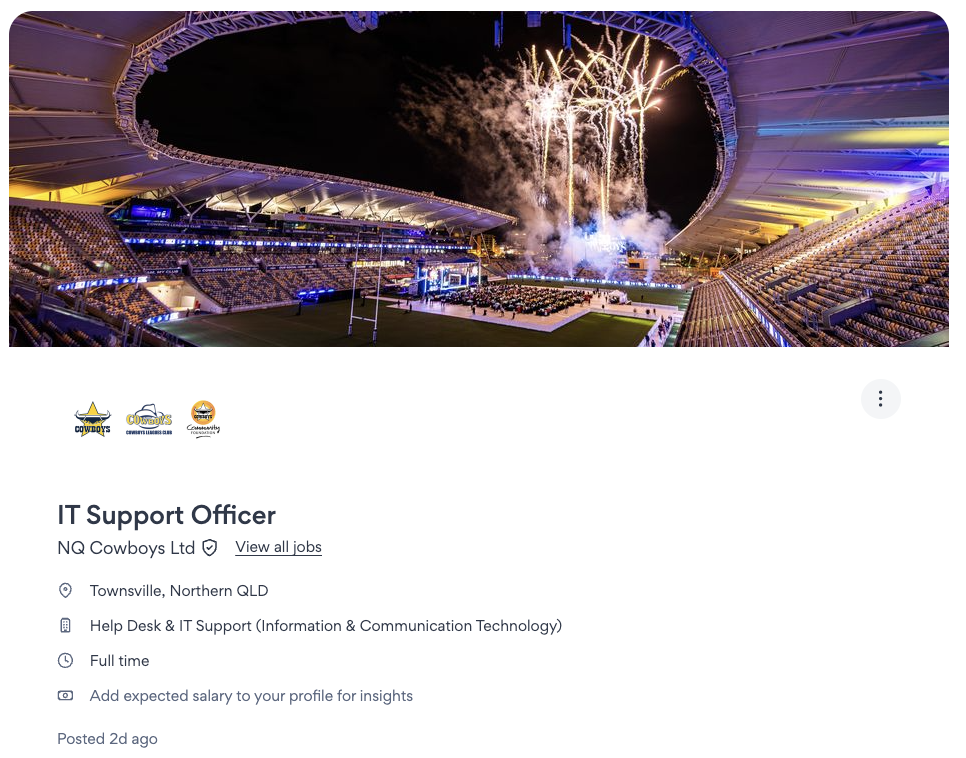 The NQ Cowboys Ltd IT Support Officer listing on SEEK, viewed July 2026. Screenshot supplied for commentary.
This is the group behind the North Queensland Toyota Cowboys, Townsville’s National Rugby League (NRL) club. The newly aligned Cowboys Group brings together the Cowboys Rugby League Football Club, Cowboys Leagues Club and Cowboys Community Foundation under one executive structure.
That context makes this more than a generic Townsville IT support job. The wider organisation spans professional sport, hospitality, licensed venues and community activity across one of the NRL’s largest geographical footprints. The advertised position supports Cowboys Leagues Club and the Group’s licensed venues—an environment where technology is directly connected to hospitality operations, staff productivity and the experience of members and guests.
The advertisement is engaging. It uses accessible language, conveys the variety of the work and makes customer service, ownership, curiosity and practical problem-solving central to the role. What it does not provide is any direct SFIA direction—or an equivalent capability framework—to explain the professional level expected.
Instead, the candidate receives a wide collection of duties:
- Level 1 and Level 2 user support,
- hardware, software, network and application troubleshooting,
- Microsoft 365 and user administration,
- network and server infrastructure,
- point-of-sale, payment and venue technology,
- documentation and asset records,
- vendor and service-provider coordination,
- cyber security initiatives and staff awareness, and
- projects, upgrades, knowledge articles and training.
That is not one capability. It is user support, infrastructure operations, systems administration, asset management, supplier coordination, security activity, change implementation and knowledge management bundled into one support-officer title.
The SFIA direction is implied, not stated
There are no SFIA skill codes, responsibility levels or capability statements in the advertisement. There is also no alternative framework that tells the candidate how the Cowboys Group distinguishes assisting, applying, enabling and owning.
Some SFIA direction can be inferred from the verbs. “Provide” support, “assist” with infrastructure, “support” cyber security initiatives, “contribute” to projects and “liaise” with vendors generally suggest a role working within established direction rather than owning those capabilities. That may point towards SFIA Level 2 (assist) or Level 3 (apply) across much of the position.
But that is my interpretation, not information the employer has supplied. The advertisement leaves important questions unanswered:
- Is the officer following documented processes or expected to create them?
- Who owns the availability and security of venue systems?
- Is there a senior technical practitioner providing designs and escalation support?
- Does “liaise with vendors” mean logging and following up requests, coordinating delivery, or assuring supplier performance?
- Does “assist with cybersecurity initiatives” mean deploying defined controls and awareness material, or identifying and assessing security risks?
- Does “contributing to projects” mean completing assigned implementation tasks or planning and leading changes?
- How much independent judgement is expected when a business-critical point-of-sale or payment service fails?
These distinctions matter more than the long list of technologies. They determine the experience required, the support a new employee should expect, how performance will be assessed and whether the title accurately reflects the job.
The advertisement explicitly refers to Level 1 and Level 2 IT support, but those are support tiers—not SFIA levels of professional responsibility. A candidate could be providing second-line technical support while operating at SFIA Level 3, for example. Reusing the word “level” without a capability reference does not explain autonomy, influence or accountability.
What a clearer capability profile might say
The wording appears to imply a profile centred on user support, with supporting capability in infrastructure operations, asset management, security and change. If that is the employer’s intention, it could be stated plainly: the officer applies established methods to varied support work, resolves non-routine incidents, maintains accurate operational information, implements assigned changes and escalates issues outside agreed authority.
The advertisement could then identify which responsibilities remain with a manager, senior practitioner or provider. That boundary would be particularly valuable in a multi-venue hospitality environment where payment, point-of-sale, connectivity and operational systems may be time-critical.
If the successful person is actually expected to own venue technology services, assure suppliers, set security requirements, approve infrastructure designs or lead projects, the support-officer framing understates the role. Those expectations would require a different SFIA profile and potentially a different title, level of experience and remuneration.
The point is not that every advertisement needs a page of SFIA codes. Three or four priority skills, their expected responsibility levels and a short statement of decision-making authority would be enough. The Cowboys advertisement shows exactly why this matters: its implied capability direction can be reverse-engineered, but a candidate should not have to do that.
For me, this local example reinforces that capability frameworks are not only for large Brisbane departments. They may be even more valuable in a Townsville organisation where one broadly defined position supports a diverse, operationally critical environment.
It does not have to be SFIA
SFIA will not be the perfect answer for every organisation. Another established capability framework—or a carefully designed internal model—may align better with an organisation’s industry, operating model and workforce practices.
The important step is choosing a coherent reference model and using it consistently.
A useful framework should help an employer describe real capability without turning a role into an unrealistic catalogue of products and certifications. It should also give employees a fair way to understand where they are now, what greater responsibility looks like and which experiences will help them progress.
SFIA is particularly useful because it is technology-neutral and descriptive rather than prescriptive. It can sit alongside ITIL, vendor certifications, formal qualifications and an organisation’s own leadership framework. Those sources answer different questions: a certification may demonstrate knowledge of a platform, while SFIA is concerned with demonstrated professional skill and responsibility in real work.
Technology service management at Level 5
The SFIA skill I keep returning to is technology service management (ITMG).
In SFIA 9, Level 5 is described as taking responsibility for the lifecycle and effective use of specific technology services. It includes leading service delivery, meeting service levels and security requirements, aligning practices across teams and providers, monitoring performance, and reporting appropriately to managers and senior users.
That description is much broader than operating a help desk or maintaining infrastructure. It is about owning an end-to-end service and ensuring that technology continues to meet organisational needs.
In practical terms, that can include:
- understanding which services are critical and who depends on them,
- coordinating internal teams, vendors and managed service providers,
- setting expectations for availability, support, security and recovery,
- keeping policies, procedures and operational practices aligned,
- monitoring performance and recurring problems,
- planning upgrades and lifecycle investment, and
- giving leaders a clear view of service health, risk and priorities.
This is especially relevant to schools, small-to-medium businesses and community organisations. Their technology may span Microsoft 365 or Google Workspace, identity, devices, networks, internet services, phones, audiovisual systems, websites, backups and specialist applications. Each component can work in isolation while the overall service remains fragile. Technology service management is the discipline of seeing and managing the whole.
Network design at Level 5
Network design (NTDS) is another area that closely reflects my professional direction.
At Level 5, the emphasis is on producing or approving network architectures, topologies and configuration information for an area of responsibility. It includes specifying connectivity, capacity, performance, interfaces, security and access; assessing risk and recovery arrangements; and presenting design views that address the needs of different stakeholders.
That is a valuable description because good network design is not just choosing switches and access points. A school campus, office, venue or multi-site organisation needs a network that supports real operational requirements. Staff, students, guests, servers, cloud services, CCTV, phones, building systems and audiovisual equipment may all require different access, security, resilience and support arrangements.
The design also has to be explainable. A technical topology is useful to an engineer, but a business leader may need a view of risk, cost, service continuity and why an investment is necessary. Level 5 recognises that both views are part of the work.
Level 5 as my professional target
Level 5 is the level I am deliberately aiming to demonstrate consistently across technology service management and network design.
My experience has progressively moved in that direction: from running a local IT support business, through infrastructure planning and state-wide education technology support in Queensland Government, to managing technology in a complex independent-school environment. The work has included Microsoft 365 and Google Workspace, endpoint management, networks, wireless, telephony, infrastructure lifecycle planning, service processes, security, procurement input, vendor coordination, documentation and communication with organisational leaders.
Parts of my current and previous work are close to the Level 5 descriptions. The honest test, however, is not whether I recognise the terminology or have occasionally performed an activity. SFIA is experience-based. The standard is whether I can show sustained evidence of responsibility, sound judgement and outcomes at that level.
That makes the framework useful for professional development. Instead of treating “senior” as a vague destination, I can ask more specific questions:
- Where have I owned a technology service from planning through operation and review?
- What evidence shows that service levels, security and quality requirements were met?
- How have I aligned practices across internal teams and external providers?
- Which network designs have I produced or approved, and how did they address capacity, security, resilience and stakeholder needs?
- Where do I still need broader scope, stronger measurement or more consistent documentation?
Those questions create a practical development plan—and better evidence for a future application—without overstating where I am today.
A useful conversation for Queensland organisations
Clearer capability language can benefit organisations across Queensland, not only large Brisbane-based departments. Employers in Townsville, Cairns, Mackay and Rockhampton compete for many of the same specialised technology skills, often with smaller internal teams and broader roles.
A well-scoped role gives a regional candidate a better reason to apply. It also helps an employer decide whether it needs a permanent employee, a developing team member, a specialist provider or a combination of these. If a role genuinely requires several unrelated skills at Level 5 or above, that may indicate the work should be shared rather than hidden behind one catch-all title.
Through Suburban Australia, I am applying the same practical thinking to technology services, systems integration and organisational improvement. Its focused service line, Suburban Secure, connects that work with cyber security, Microsoft 365 hygiene, access, backups, networks and supplier review. A capability framework helps keep those conversations centred on required outcomes and responsibility—not products for their own sake.
For me, that is the real value of SFIA. It helps employers say what they actually need, helps professionals explain what they can demonstrate, and gives both sides a clearer language for the next level of capability.
SFIA is maintained by the SFIA Foundation. This article is independent professional commentary; no affiliation or endorsement is implied.