North Queensland Cyber Watch: Storm names Westco Motors Cairns in ransomware claim
This is the seventh entry in North Queensland Cyber Watch, an ongoing series looking at cyber security incidents that affect our region and what organisations here can take from them.
This entry needs a careful first sentence: the Storm ransomware group has claimed it breached Westco Motors Cairns and has named the dealership on its dark-web leak site. That is a serious allegation, supported by reporting that sample documents have been published, but it is not the same as confirmation from Westco Motors or a completed forensic investigation.
At the time of writing, I have not located a public incident statement from Westco Motors. Cyber Daily reported on 24 August that it had contacted the dealership and had not yet received a response.
That distinction matters. Ransomware leak sites are operated by criminals with a financial interest in creating pressure. Their claims cannot be treated as neutral evidence, even when they publish material that appears to come from the organisation they have named.
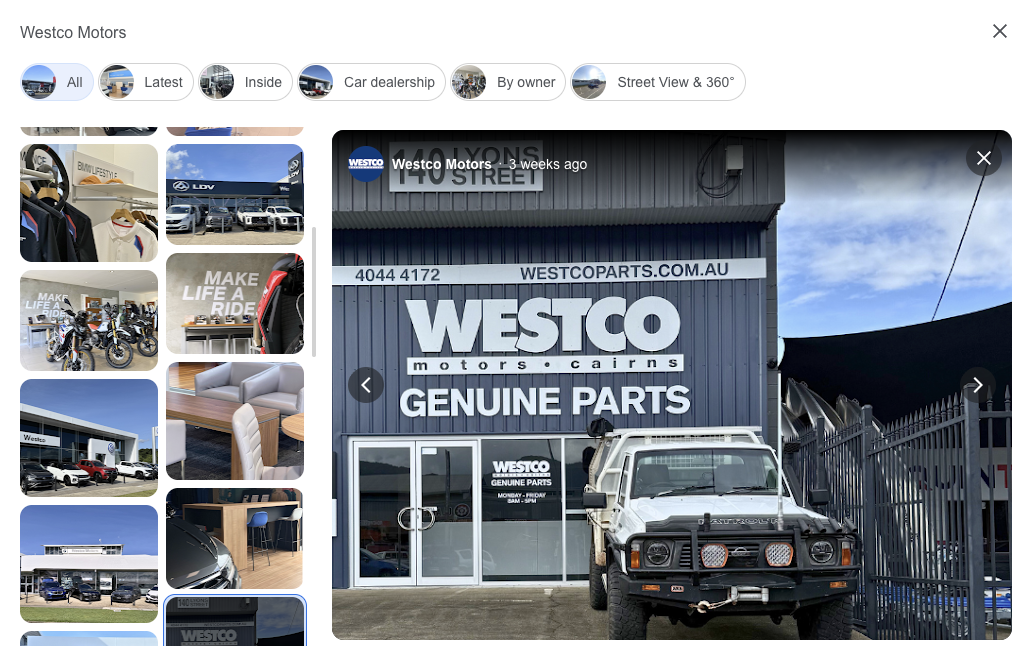
Header image: Westco Motors photo gallery on Google Maps, supplied as a screenshot for this article. Image source: Google Maps.
What has been reported
According to Cyber Daily, Storm posted its claim on 17 August 2026 and published more than a dozen documents it said were taken from Westco Motors. The publication reported that the samples included tax invoices, vehicle identification numbers and customer contact details containing email addresses and mobile phone numbers.
Cyber Daily also reported that Storm had not disclosed the total volume of data it allegedly took or any details of its ransom demand. The group had nominated 12 October as the date on which it would publish the data, an unusually long interval for an extortion deadline.
Two threat-intelligence sites also recorded the claim:
- HookPhish published an incident entry on 18 August, identifying Westco Motors, its domain and Storm as the claiming group. Although that entry describes the attack as fact, its information is sourced from public threat-intelligence feeds rather than a statement from Westco Motors.
- SOCRadar recorded Westco Motors as a Storm ransomware listing and discussed other Australian organisations reportedly listed around the same time.
The date difference is readily explained: Cyber Daily refers to the threat actor’s 17 August leak post, while the monitoring entries describe discovery or publication on 18 August.
What is reported, alleged and still unknown
The most responsible way to read the information available tonight is to keep three categories separate.
- Observed and reported: Storm named Westco Motors Cairns on its leak site. Cyber Daily reported viewing more than a dozen sample documents published by the group and described the kinds of information visible in them.
- Alleged by Storm: the group breached Westco Motors, stole a larger body of data and is in a position to publish it later.
- Not publicly confirmed by Westco Motors: that an intrusion occurred; that the displayed documents came from a breach of its own environment; how any access occurred; what systems or third parties may have been involved; how many people may be affected; the full categories and volume of information; whether operations have been disrupted; and whether the dealership has received or responded to a ransom demand.
It would therefore be premature to call this a confirmed Westco Motors data breach. It would also be unwise to dismiss the claim merely because the dealership has not yet made a public statement. Incident response takes time, and an organisation may need to contain access, preserve evidence and determine who is affected before it can say anything useful.
If Westco Motors publishes an update, its account should take precedence over assumptions drawn from the criminal group’s site.
A stealer-log search does not establish the entry point
SOCRadar says its query of a bounded sample of stealer-log data returned no record for the westcomotors.com.au domain. The caveat is more useful than the result: a limited search cannot prove that relevant credentials do not exist in another dataset, under another corporate domain or through an employee’s personal account.
More importantly, it tells us nothing conclusive about this alleged incident. There is currently no public evidence showing whether initial access involved stolen credentials, phishing, an exposed remote service, a vulnerable device, a supplier or something else entirely.
That matters because speculative attribution can send defenders in the wrong direction. Credential hygiene and monitoring remain sensible controls, but they should sit inside a broader assessment rather than being presented as the answer to an entry method nobody has established.
Why a motor dealership holds attractive data
Westco Motors describes itself as a locally family-owned, multi-franchise dealership employing more than 100 people. Its business spans new and used vehicle sales, trade-ins, servicing, parts and finance-related workflows.
That combination creates a broad information footprint. Depending on the transaction and the systems involved, an automotive business may handle customer contact details, invoices, vehicle and registration information, finance applications, proof-of-identity documents, payment records, service histories, staff information and communications with manufacturers, lenders, insurers and other suppliers.
This is not a claim that every one of those categories was involved here. Cyber Daily’s report is much narrower: it says Storm’s samples included invoices, vehicle identification numbers and customer email addresses and mobile numbers.
Even that narrower combination can support convincing follow-on scams. A criminal who knows the dealership, a customer’s vehicle and the shape of a genuine transaction has the context to imitate a service reminder, invoice adjustment, finance query, parts order or registration problem. The danger is not only what each field reveals alone, but how authentic details can make the next message sound legitimate.
What Westco Motors customers should do
There is not enough confirmed information to assume that every Westco Motors customer is affected, cancel a card or change an unrelated password solely because of this claim.
There are still some sensible precautions while the facts develop:
- Treat unexpected calls, emails and text messages about Westco invoices, finance, vehicle servicing, parts or refunds cautiously.
- Do not make a payment or disclose information using contact details supplied in an unexpected message. Find the dealership’s number or website independently and verify the request through that channel.
- Never provide a password, payment detail or one-time security code to somebody who contacts you.
- Be wary when a caller knows your name, vehicle or a genuine transaction. Accurate background information can be part of the impersonation, not proof the caller is legitimate.
- Keep any genuine Westco correspondence and watch for a direct notice that explains whether your information was involved and what action is recommended.
- Report suspicious messages to Scamwatch. If identity information is later confirmed as affected, IDCARE provides specialist support.
The lesson for Cairns and Townsville businesses
The value of this story is not in guessing what happened inside one local company. It is in asking whether another North Queensland business would be able to prevent, detect and contain the common paths into ransomware — and keep operating if prevention failed.
For businesses across Cairns and Townsville, this is a good prompt to have both the IT environment and the workflows around it assessed against recognised good practice. A technical scan alone will not show who emails identity documents, where finance paperwork is copied, which supplier can reach a system, how an urgent bank-detail change is approved or whether staff can serve customers when the main platform is unavailable.
A practical review should cover:
- where customer, staff and financial information is collected, copied, shared and retained;
- multi-factor authentication, especially for email, remote access and privileged accounts;
- patching and exposure of internet-facing systems;
- separate administration accounts and least-privilege access;
- endpoint protection, central logging and alert review;
- tested, isolated backups and a restoration order for critical systems;
- vendor and cloud-platform access, including who remains authorised after a role or supplier changes;
- manual alternatives for sales, bookings, invoicing and customer communication; and
- a written incident response plan that names decision-makers, advisers, regulators and communication channels.
ASD’s Australian Cyber Security Centre publishes the Essential Eight as a baseline for making systems harder to compromise, together with practical ransomware guidance. The point is not to claim vague “compliance with best practice”. It is to identify which recognised controls are appropriate, document the gaps and make sure the controls work in the real business rather than only on paper.
If your organisation wants an independent, practical assessment of its workflows and IT environment, Suburban Secure works with businesses in Cairns and Townsville on Microsoft 365 hygiene, identity and access, backups, networks, incident readiness and alignment with recognised security baselines.
Suburban Secure is designed to be an independent partner and second set of eyes, not another traditional MSP trying to replace the provider you already have. The review is not built around winning a long-term managed-services contract, adding more licences or selling a preferred technology stack. The findings and recommendations belong to the business, and the business can choose whether Suburban Secure, its internal team or its existing MSP carries out the work. That separation helps keep the advice focused on the organisation’s risks and outcomes rather than a provider’s recurring-services agenda. You can read more about why Suburban Secure is not trying to be your next MSP or request an independent second opinion.
For now, the accurate headline remains that Storm has made a claim and published samples that Cyber Daily says contain customer and transaction information. Westco Motors has not publicly confirmed the incident. That is enough reason for customers to be alert and for other regional businesses to review their own readiness, but not enough reason to turn an allegation into a settled fact.