From one bar to better coverage: regional connectivity in North Queensland
Header photograph: a mobile tower at sunset. Photo by Charlie Fitzgerald on Unsplash.
I remember travelling to Ravenswood as a technician with two phones: my personal phone on Optus and my work phone on Telstra. Neither gave me a connection I could depend on.
The Telstra work phone would lose reception indoors. Even standing outside near the local pub, calls would only connect intermittently. I remember holding the phone towards the sky, trying to scrape together a single bar of reception.
That experience stays with you when you read an announcement about another regional telecommunications upgrade. You think about the people who live there every day, and what it would mean to make a call without first finding the right patch of ground.
It is why I welcome the completed North Queensland projects under the Australian Government’s Regional Connectivity Program (RCP). Ravenswood and Forrest Beach give us concrete examples of funded infrastructure reaching communities that had been asking for better service for years.
Travelling around regional Queensland for work gave me an appreciation of how uneven connectivity can be. A town can feel reasonably close to Townsville while still presenting a very different problem for somebody trying to support a business, connect a remote workplace or simply stay contactable.
Palm Island illustrates how geography complicates that task. A 2012 telecommunications infrastructure review for Townsville and North West Queensland documented a microwave link from the mainland to a Telstra tower on the island, with hills separating residential areas and making wireless delivery difficult. It is a historical account, but a useful reminder that getting a connection to an island and distributing coverage around it are two engineering challenges.
Low Earth orbit satellite broadband, including SpaceX’s Starlink, has since added another option for remote sites. The Queensland Government’s 2024 satellite initiative is one public example of its use to improve connectivity in remote First Nations communities. That is a separate initiative from the federal RCP. A satellite connection serving a building can be valuable alongside the mobile infrastructure needed by people moving around a township.
The Regional Connectivity Program funds telecommunications projects designed around the needs of particular places. Its scope includes mobile coverage, fibre and fixed wireless broadband, and the microwave or fibre links that carry traffic back into wider networks. State and local governments, providers and other contributors can also help fund projects.
Across Rounds 1, 2 and 3, the department reports $370.3 million, including GST, awarded towards up to 298 projects. Those are funding awards; the rollout reports show how individual projects have progressed.
For Kennedy, the local scale was substantial. In a 12 May 2022 media release, Bob Katter welcomed approximately $20 million in Round 2 announcements across the electorate. The list stretched from coastal communities to the Gulf and western Queensland, covering several different types of infrastructure.
The following table pairs the amounts in that announcement with the status recorded in the department’s June 2026 rollout update, pages 51–54.
| Location or project | Funding announced in May 2022 | Infrastructure | Status in June 2026 report |
|---|---|---|---|
| Ravenswood | $904,700 | Telstra macro mobile site | Complete, Q2 2024 |
| Forrest Beach / Allingham | $785,350 | Telstra macro mobile site | Complete, Q4 2024 |
| Doomadgee | $957,200 | Telstra macro mobile site | Complete, Q3 2024 |
| Julia Creek | $4,183,082 | NBN fibre to the premises | Complete, Q3 2024 |
| Boulia | $2,959,562 | NBN fibre to the premises | Complete, Q2 2024 |
| Burketown–Normanton | $7,404,450 | 226 km fibre link | Complete, Q4 2024 |
| Gulf Development Road | $1,000,800 | Fixed wireless, backhaul, Wi-Fi and sensor network | Complete, Q3 2024 |
| Richmond–Croydon Road | $459,600 | Fixed wireless, backhaul, Wi-Fi and sensor network | Complete, Q3 2024 |
| Mareeba–Cairns Road | $1,846,393 | Proposed fixed wireless extension | Removed |
The amounts above are the announced funding figures, rather than a statement of final expenditure. The Mareeba–Cairns Road project is recorded as removed, so it belongs outside the list of delivered successes.
There is still plenty here to welcome. A new mobile site addresses a different need from a fibre connection into a town or a long fibre route between communities. Reliable regional communications depend on that wider network as well as the signal reaching somebody’s handset.
Ravenswood is the project that particularly catches my attention. The government records its new Telstra macro mobile site as completed in April–June 2024, with improved handheld coverage as the project objective. A macro site is the larger type of mobile base station used to cover a surrounding area.
On my last visit in 2023, my personal Optus phone still had no usable reception in Ravenswood. My recollections of both networks come from before the Telstra project’s reported completion in 2024.
The Ravenswood result I saw on Telstra’s coverage map showed good 4G coverage. That is encouraging, although I would like to experience the improvement on a return visit. For the everyday work of making calls, sending messages and getting online, dependable 4G would be a substantial improvement on the reception I remember.
Forrest Beach has a particularly clear public account of the community effort behind its upgrade. Katter’s 2022 announcement described residents gathering with Bob Katter and Nick Dametto in November 2021 to press for better telecommunications. At that time, Dametto was the state Member for Hinchinbrook.
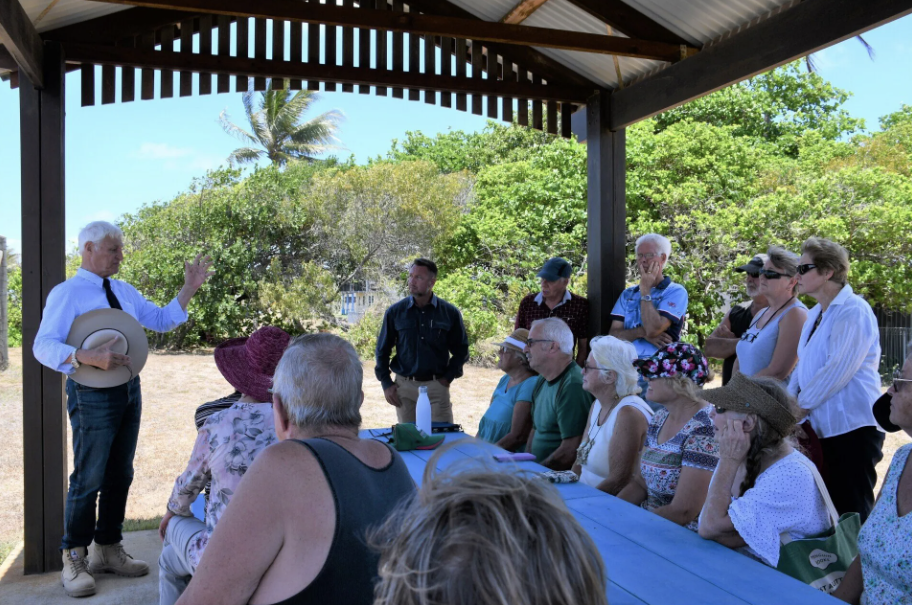 Community photograph accompanying Bob Katter’s May 2022 funding announcement. Nick Dametto appears in the background in his then role as Member for Hinchinbrook. Image source: Bob Katter’s website.
In its 20 November 2024 completion announcement, Katter’s Australian Party welcomed the finished Forrest Beach tower and acknowledged the community’s persistence. The timing agrees with the government’s Q4 2024 completion record. Residents had waited more than two years after the funding announcement to reach that point.
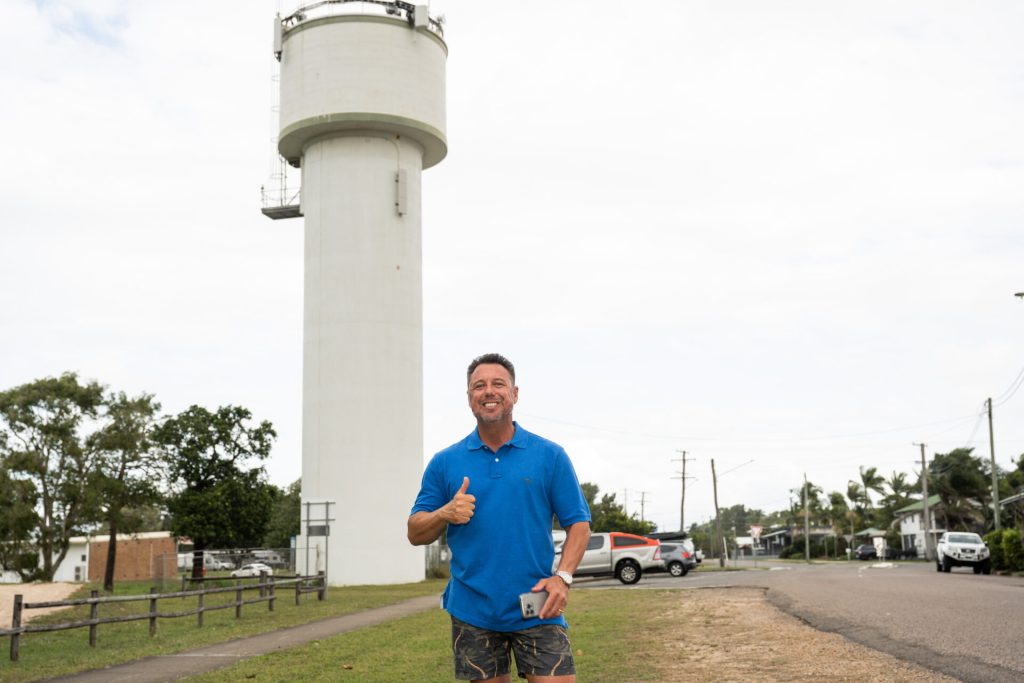 Nick Dametto at the Forrest Beach Telstra site location, while Member for Hinchinbrook. Image source: Katter’s Australian Party, 20 November 2024.
Readers of my earlier article, The problem with being called Nick in Townsville, will recognise Dametto, now Mayor of Townsville. These photographs show an earlier chapter, when his work as Hinchinbrook MP included the community’s campaign for coverage.
Those local efforts deserve recognition, alongside the federal funding and the work required to deliver the infrastructure. For residents, the useful outcome is being able to contact family, organise appointments and run a business with a service they can depend on.
There has also been a useful change in how we assess coverage claims. Since 30 June 2026, ACMA’s rules have required standardised 4G and 5G coverage maps using good, moderate, basic and no coverage categories. Providers must explain those categories in plain English and update the maps at least every three months.
That helps give the word “good” a more consistent meaning. It also makes comparing providers more useful for somebody choosing a service for a regional address.
Telstra explains that the maps predict outdoor coverage under typical conditions. Buildings, terrain, devices and network demand can still affect the experience. A good result on the map therefore needs to be understood in that context when planning connectivity inside a home, shop or school.
The changed mapping thresholds also explain why a provider’s displayed footprint can shrink without a corresponding loss of infrastructure. Telstra says the introduction of the new maps did not change its actual network coverage. Clearer reporting helps us judge the service being offered; completed infrastructure projects are what give places such as Ravenswood a reason to expect an improvement.
I have written before about digital inclusion in North Queensland. Infrastructure is one part of that broader challenge, alongside affordability and the ability to use online services. For people who have spent years working around poor reception, a completed connection is a practical step forward.
The Regional Connectivity Program deserves credit for the projects it has delivered across Kennedy. There is more work to do, and the rollout records should continue to be checked against the announcements. But I welcome seeing Ravenswood and Forrest Beach among the completed projects. Having once stood outside in Ravenswood searching for a bar of reception, I have a very practical reason to care about what comes next.