Announced, welcomed, then refused: what happened to Townsville's $42.1m affordable housing precinct?
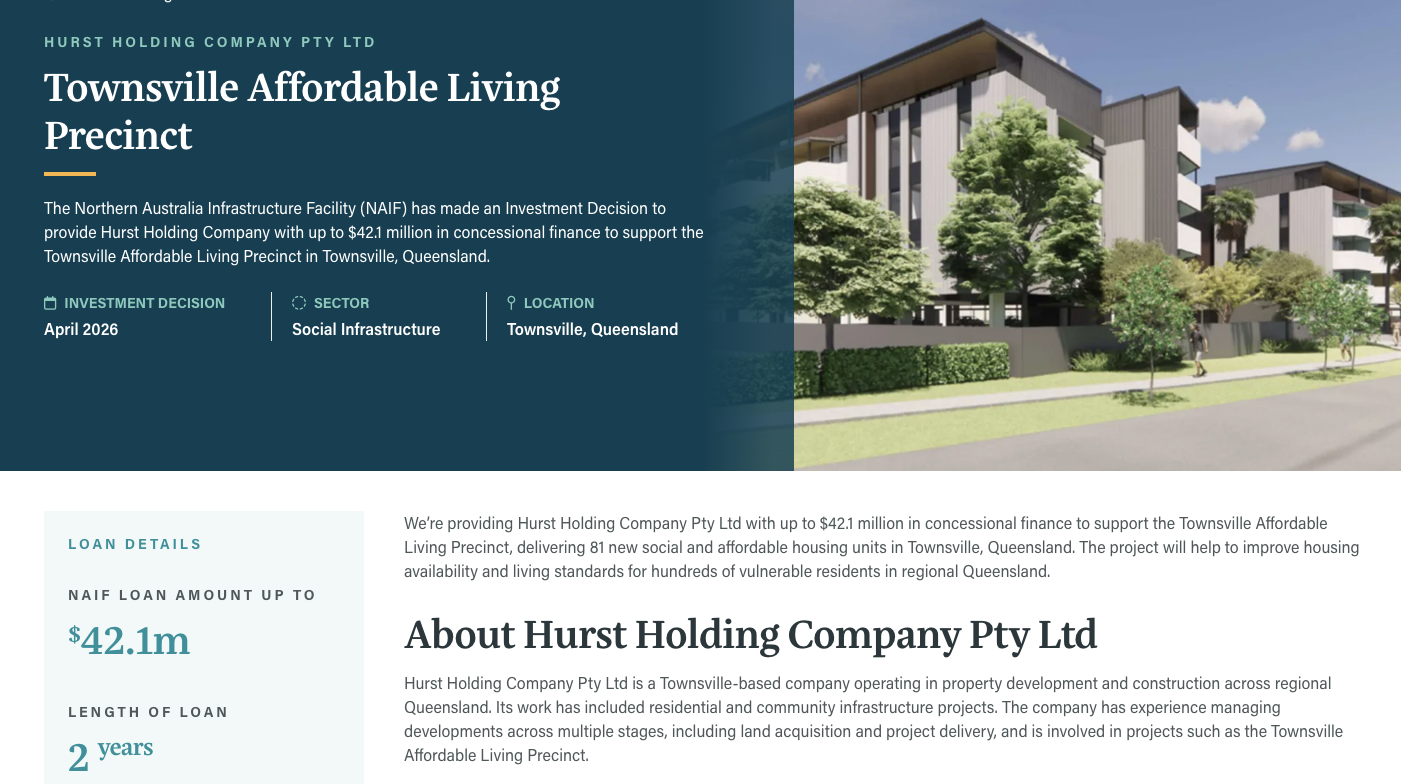
In April, Townsville appeared to have another housing win.
An Australian Government-backed loan of up to $42.1 million would help a local developer build 81 social and affordable homes, with room for as many as 240 residents. The announcement was welcomed by Townsville Enterprise, promoted by the Northern Australia Infrastructure Facility and presented as an important response to one of the region’s most pressing problems.
Hurst Constructions wanted to “break ground as soon as we possibly can”.
Less than three months later, Townsville City Council refused the development application.
The proposed Townsville Affordable Living Precinct is an interesting planning story in its own right. It also raises a broader question about how we talk about economic development in regional cities like Townsville.
We hear plenty when projects are announced. Who tells us what happened afterwards?
The April announcement
On 23 April 2026, the Northern Australia Infrastructure Facility announced a loan for the Townsville Affordable Living Precinct. Townsville Enterprise welcomed the news on the same day.
The headline numbers were substantial:
81 dwellings: 21 social-housing units and 60 affordable-housing units
accommodation for up to 240 people
about 153 full-time-equivalent jobs during construction
seven ongoing jobs once operating.
Townsville Enterprise connected the project to the region’s housing shortage and its wider pipeline of more than $40 billion in proposed development. That made sense. A growing regional economy needs somewhere for workers and their families to live, while people already struggling in a tight rental market need secure and affordable homes.
NAIF’s project page for the Townsville Affordable Living Precinct, captured in August 2026.
It was finance, not a $42.1 million grant
The language matters here.
NAIF made an investment decision to offer up to $42.1 million in concessional finance. Its investment-decision register breaks that into a $40.3 million construction facility and a $1.8 million cost-overrun facility. The project page records a two-year loan term.
That is government-backed finance, not a conventional grant or an immediate transfer of $42.1 million in public money.
NAIF estimated a modelled public benefit of $36.2 million across construction and 20 years of operation. Its project page also says Regional Housing Limited would purchase and manage the development after completion. In other words, Hurst was to develop the project, with a community-housing provider intended to become its long-term owner and operator.
Concessional finance can be a legitimate way for government to help worthwhile projects cross the gap between a good idea and a deliverable one. But an investment decision is not the same thing as development approval, and neither is the same thing as completed homes.
That distinction was easy to miss in the optimism of the April announcement.
The project behind “around eight kilometres from the CBD”
The initial public announcements did not give the street address. Council’s planning records do.
The application was MCU25/0075 — Multiple Dwelling (81 dwelling units) at 344–346 Ross River Road, Cranbrook, with associated land. Rather than a detached-house estate, the plans showed two five-storey apartment buildings on an infill site fronting one of Townsville’s busiest arterial roads.
The Townsville City Council ePlanning record shows that the application was lodged on 27 October 2025. By the time the finance announcement was made on 23 April 2026, planning assessment was still under way. An information response was recorded on 29 April, public notification ran through May, and the decision came in July.
There is nothing inherently improper about announcing a finance decision before planning approval. Infrastructure funding commonly depends on conditions being satisfied before money can be drawn. But it does mean the homes were not yet construction-ready when they were publicly celebrated.
Access became the central practical problem
Ross River Road is a state-controlled road, so the access proposal required state assessment as well as Council approval.
In November 2025, the State Assessment and Referral Agency requested more information. The proposed left-in/left-out driveway was within the functional area of the Ross River Road and Acheron Avenue intersection. The state asked for more traffic modelling and a design showing how unsafe vehicle movements would be prevented.
The eventual outcome is more nuanced than saying Transport and Main Roads simply prohibited access to Ross River Road.
In May, TMR approved a permitted road-access location subject to conditions. Its decision material records a one-way egress driveway at the rear of the site, through a four-metre-wide unnamed laneway to Albert Street. Council’s later refusal notice says all routine vehicular egress would be directed through that laneway and onto the local residential street.
That arrangement solved one state-road safety problem but contributed to a different local planning problem: whether a constrained rear lane and residential street could reasonably handle traffic from 81 apartments.
Council’s refusal went beyond one road
Council refused MCU25/0075 on 15 July 2026 and issued its decision notice on 23 July. The official notice gives five grounds:
Traffic, access and road-network function: Council was not satisfied with all routine egress being concentrated through the Albert Street laneway.
Residential amenity: Council cited traffic impacts, overlooking and privacy, and the intensity of occupation.
Pedestrian and cyclist safety: Council was not satisfied the constrained access environment could safely accommodate vehicles, pedestrians and cyclists.
Scale and intensity: Council considered the proposal an overdevelopment of the site when its access, traffic and surrounding residential properties were taken into account.
Parking and local amenity: Council was not satisfied that the proposed parking would meet resident and visitor demand without overflow into surrounding streets.
Six public submissions had been received. They raised parking, infrastructure, traffic, building height, noise and flooding. The refusal notice records flooding concerns about Albert Street, but the formal decision was broader than flooding alone.
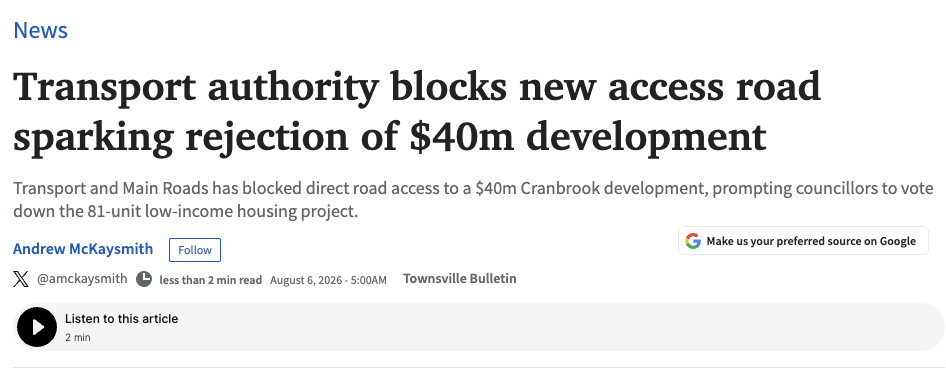 A Townsville Bulletin article listing on 6 August 2026 brought wider attention to the refusal. The Council decision record provides the fuller set of reasons.
This distinction matters. A simple headline about a transport authority blocking a road does not capture the entire assessment. TMR’s concerns helped shape the access arrangement, while Council ultimately had to decide whether the overall development worked on this particular site.
It decided that it did not.
Refusing this proposal is not refusing affordable housing
Townsville needs additional housing. It particularly needs homes that people on low and moderate incomes can afford.
The refusal of this application does not establish that social housing is a poor use of public support, or that an 81-home development should never be built in Townsville. Council’s reasons were about this proposal’s scale, access, traffic, safety, parking and effect on its neighbours.
The real question was not whether Townsville could use another 81 homes. It was whether this site and design could safely and practically deliver them.
That is an important distinction for both supporters and critics of publicly backed housing. Good intentions do not remove the need for sound planning. Equally, a planning refusal should not become an excuse to abandon housing supply that the community still needs.
What happens after an announcement?
As at 16 August 2026, NAIF’s website still lists the project status as Investment Decision and describes the benefits the completed development is expected to deliver.
That may simply reflect an unresolved situation. The applicant may have appeal rights, may redesign the proposal, may pursue another access solution or may consider a different site. A refusal is a significant setback, but it does not answer every question about what happens next.
It does leave some reasonable questions for the organisations involved:
Has any of the NAIF facility been drawn, and was planning approval a condition of drawing it?
Does Hurst intend to appeal, redesign or relocate the project?
Is Regional Housing Limited still committed to acquiring the completed development?
Are the 81 dwellings still counted in Townsville’s expected housing and development pipeline?
Will the public project pages be updated as the proposal’s status changes?
These questions are not an allegation that somebody has misused $42.1 million. The publicly available material describes a financing commitment, and I have not seen evidence that the full facility was advanced or spent. They are questions about accountability, current information and whether a publicly celebrated proposal is still capable of delivering the promised outcome.
Townsville Enterprise should be interested in the follow-up
Townsville Enterprise did not assess this application. It does not control TMR and did not make Council’s decision. There is nothing unusual about the region’s economic-development organisation welcoming new investment.
But by promoting the project, Townsville Enterprise gave the announcement additional local credibility. It connected the proposal to housing affordability, workforce attraction and Townsville’s much larger development pipeline.
That makes the follow-up part of the economic-development story too.
Does Townsville Enterprise still support this project? Does it see the access issue as a constraint worth advocating to resolve? Is it encouraging a redesign or alternative site? When an announced project is delayed or refused, does it revise the pipeline figures used to shape expectations about jobs, housing and growth?
Regional advocacy organisations are understandably good at amplifying announcements. We should expect the same interest in outcomes.
Public support deserves patient scrutiny
My own involvement in community housing gives me a definite view on this: public finance can help turn housing proposals into real homes, and in many cases it should.
It also makes me conscious that public support carries responsibilities. A project should be assessed honestly, risks should be visible and the community should be able to tell the difference between money announced, finance committed, approvals obtained, construction started and homes occupied.
Those are five different milestones.
Townsville has other social-housing proposals moving through different pathways. One is MID-0426-1011 at 38 Canterbury Road, Kirwan, proposed by Northreach Community Care.
That proposal has used Queensland’s Ministerial Infrastructure Designation process, an alternative planning pathway for certain community infrastructure, including social and affordable housing. It is not evidence that one approval process or project is automatically better than another. It simply shows that housing proposals across Townsville are progressing through different systems, with different sites, constraints and stakeholders.
Because of my direct involvement, I will cover Canterbury Road separately rather than use this article to argue its merits.
The announcement should be the start of the story
None of this means Townsville should stop celebrating new investment.
Announcements help build confidence, attract attention and show what may be possible. But proposed investment is not delivered investment. Forecast jobs are not jobs created. Announced homes are not completed homes.
For a growing regional city with genuine housing and infrastructure pressures, following projects through finance, planning, construction and completion matters just as much as welcoming them at the beginning.
The Cranbrook proposal may yet return in another form. If it does, the next announcement should explain what changed and how the problems identified by Council have been resolved. If it does not, the region deserves to know what replaces those 81 homes in the housing pipeline.
A press release can announce 81 homes in a morning. Delivering 81 homes is considerably harder.
Disclosure: I am chairperson and a director of Northreach Community Care Ltd, a Townsville community-housing provider. I have also been involved in the proposed Canterbury Road social-housing development mentioned in this article. My role is recorded on the ACNC Charity Register. The views expressed here are my own.
This article is based on public records available on 16 August 2026. The Council ePlanning record should be checked for any later appeal, amended application or other change in status.